

Each organization is made up of employees of varying calibers, each with varied performances and potentials. According to Gartner’s research, a high potential employee adds nearly double the value to an organization and is three times as likely to become a future excellent leader. As a result, knowing the distinction between high potential and high performer personnel can be quite beneficial to your business.
Table of Contents
Why do we need to distinguish between High Potentials vs. High Performers?
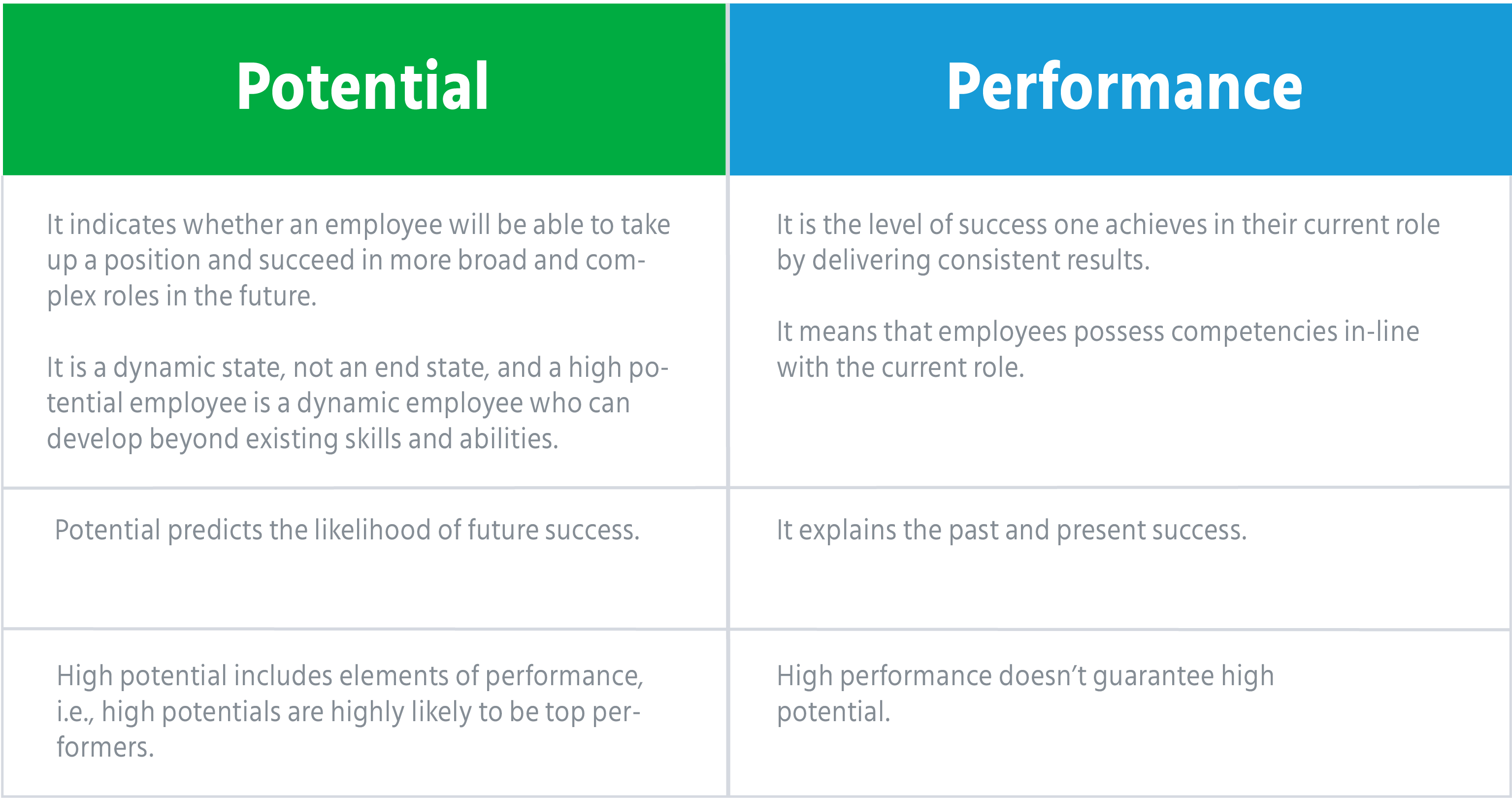
“If an organization is not able to distinguish between performance and potential, it will have difficulty identifying talent,” says Vincent van de Belt, director of the Vanderbilt & Partners talent management consultancy.
Top performers are promoted to sales manager and then they struggle to handle that position, according to reports from around the world. They sabotage their own sales goals, which has an impact on the younger reps’ team, and they sabotage their own goals. Meanwhile, the junior sales rep, whose hard work has led sales teams to excel for years, begins to feel unappreciated and decides it’s time to explore new better-paid opportunities. This results in the loss of top employees who had a huge potential to be great in the future. This results in the loss of top employees who had a huge potential to be great in the future. Both of these scenarios have a negative impact on the company’s morale and productivity, as well as turnover.
A manager who understands the distinction between a high potential employee and a high performer will be more effective in engaging and retaining employees who exhibit talent in a variety of areas. This article addresses strategies for identifying, assessing, and developing high potentials and high-performing employees that any manager can employ. Let’s have a look at these strategies in more detail:
Identifying High Potentials And High Performers

Employees with high potential have the capacity, motivation, and desire to advance and perform in greater senior and crucial roles. High potentials are different from the rest. “High potentials have demonstrated an initial aptitude for their technical abilities and have future potential to make a huge difference,” says Malcolm Munro, founder, and CEO of Boss Builders. They have the potential to accomplish more for the organization in the future than anyone realizes now. High potentials who regularly underperform are rarely great candidates for crucial posts, notwithstanding their rarity.
Spotting high-potential employees might be difficult for two reasons:
- Firstly, high performance is so evidently easy to observe that it diminishes out the less apparent attributes and behaviors that define high potentials.
- Second, just a few companies concentrate on the qualities and skills that they want in their ideal employees. Managers are unable to assess an employee’s potential since they are unsure of what to look for in a candidate. Due to this fact, the majority of the managers focus exclusively on performance and overlook candidates with huge potentials.
When performance is the prime requisite by which employees are assessed, high performers will be the only ones to advance, and high potentials will seek opportunities somewhere that recognize their potential.
This isn’t to say that you shouldn’t recognize and reward achievement. Performance should be highly valued and rewarded. However, if your ultimate aim is to develop a more robust and skilled organization, then performance cannot be the only evaluating factor.
High-performing employees, on the other hand, prioritize quality in the workplace. They are really efficient at what they do and put in a lot of work. In any organization, high performers stand out clearly from average performers. They constantly exceed expectations and are selected by management for complex projects due to their track record of completing tasks efficiently. They’re good at what they do and are accountable for their performance and they celebrate their achievements. Although, they might not have the potential or desire to advance to a more powerful position or take on more difficult tasks.
One helpful method to differentiate between them can be to work along with leadership to define what constitutes greatness in critical roles and then share that information with managers to assist them in identifying high-potential employees.
Assessing Potential Vs. Performance
You should evaluate your employees in both categories since they have varying levels of performance and potential. Here’s how to figure out where an employee sits on the spectrum between these two criteria:
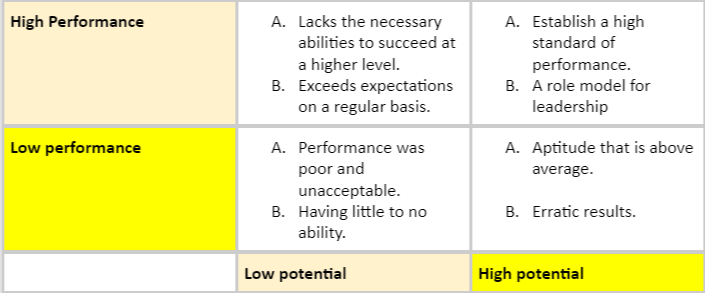
“Each of these categories requires a specific approach when it comes to discussing development opportunities,” says van de Belt. You can construct an employee development plan after determining which quadrant an employee belongs to.
Development Strategies
A manager’s dream is for every employee in their organization to be a high performer with high potential, however, in an ideal environment, this is obviously not possible.
You should decide if you want to move an employee to the upper-right quadrant, or at the very least to the high-performance tier. This isn’t always feasible, and it’s not always the intended outcome. For example, you might desire to keep your top performers in their current positions. There is no such thing as a one-size-fits-all strategy, but here is a conceptual approach to consider:
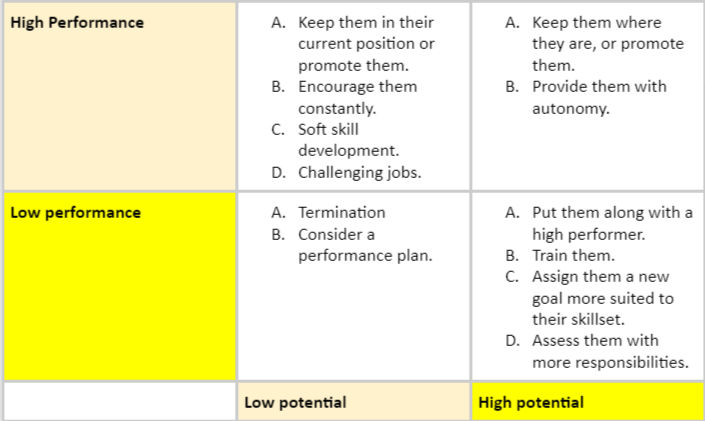
Munro says “High performers need constant encouragement and challenging assignments. Recognition is key”.
High performers have a lot of motivation to do things on a larger scale. Provide them with the independence and autonomy they need to excel and include them in projects that they can fully own.
“They need to recognize that while they are great potential, they require seasoning,” Munro says, recommending connecting high-potential employees with dignified top achievers who can serve as mentors.
As they gain a better understanding of the organization and their role within it, put high potentials to the test with tasks like:
- Taking on more projects..
- Taking up the responsibility of one or two interns.
- Training new recruits.
- Participating in cross-training opportunities.
If they perform well, consider shifting them to a new role with increased responsibility, where they will be able to excel.
A Stronger Talent Pipeline For A Stronger Company

As a people manager, you play a critical role in developing a pipeline of strong personnel, and it’s becoming increasingly crucial that you succeed.
While staff development is a difficult task, failing to analyze performance versus potential can be a big threat to your business.
Final Thoughts
The good news is that with effective planning and administration, you can solve this problem. Identifying your high potential and high performing employees, analyzing their competencies and traits, and putting them on the path to success requires nothing more than commitment and a keen eye. The time and resources you put into this will not be wasted, and you will have a stronger talent pipeline as a reward. To read more articles on team management check out our blog!
