

Modern businesses are facing a growing compliance paradox. Privacy regulations are expanding in scope and enforcement, while traditional enterprise compliance tools remain expensive, slow to deploy, and operationally heavy.
Captain Compliance was built to close this gap. It delivers enterprise-grade data privacy and AI governance capabilities at a mid-market price point, without the complexity and cost traditionally associated with large compliance platforms.
The Privacy Paradox: Regulatory Complexity vs. Enterprise Cost
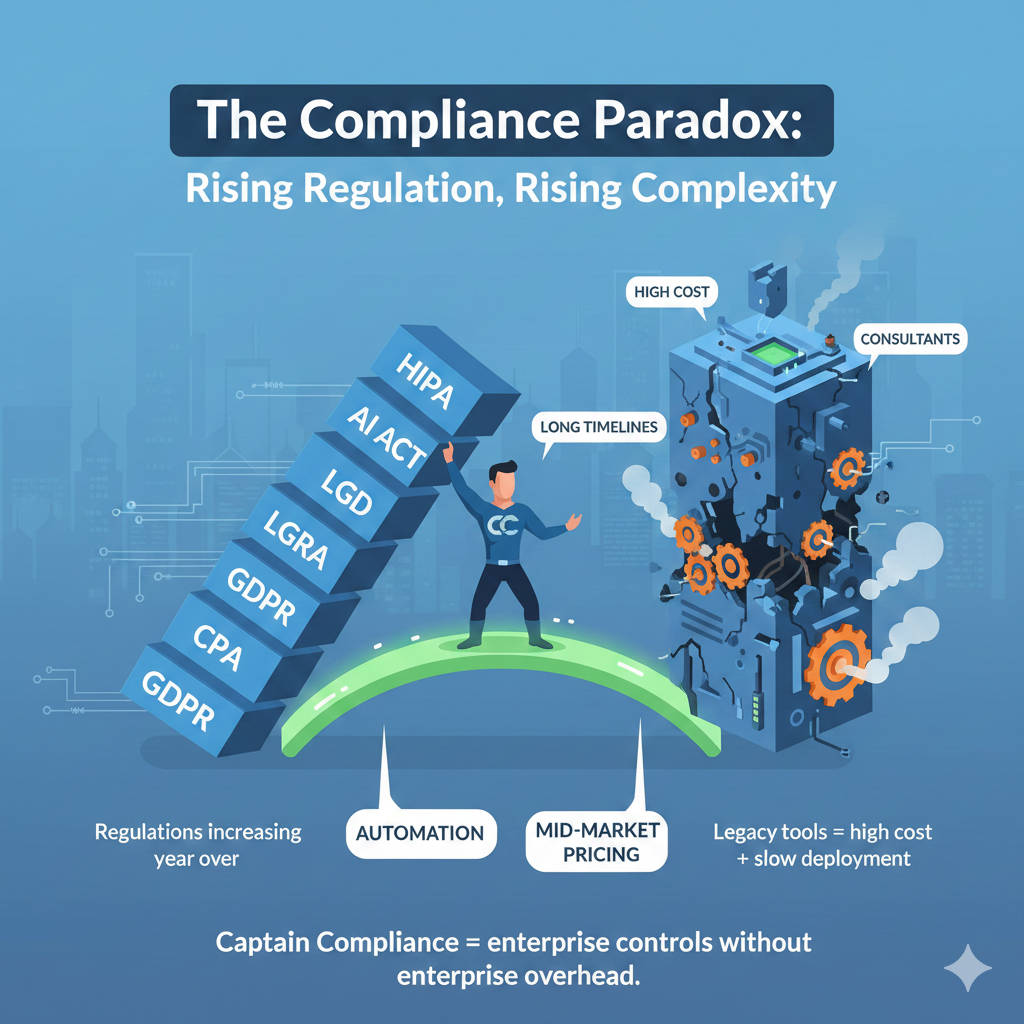
Privacy compliance is no longer optional. Regulations such as GDPR, CCPA and CPRA, Virginia Consumer Data Protection Act, Brazil’s LGPD, and emerging AI-specific laws demand strict controls over how organizations collect, process, and govern personal data.
At the same time, legacy enterprise privacy platforms often introduce new challenges:
- Six-figure pricing models
- Lengthy implementation cycles that last three to six months
- Heavy reliance on consultants and fragmented tooling
Captain Compliance enters the market as a disruptor, designed for organizations that need enterprise-level security and automation without enterprise-level overhead.
Automation First: From Reactive Compliance to Autopilot
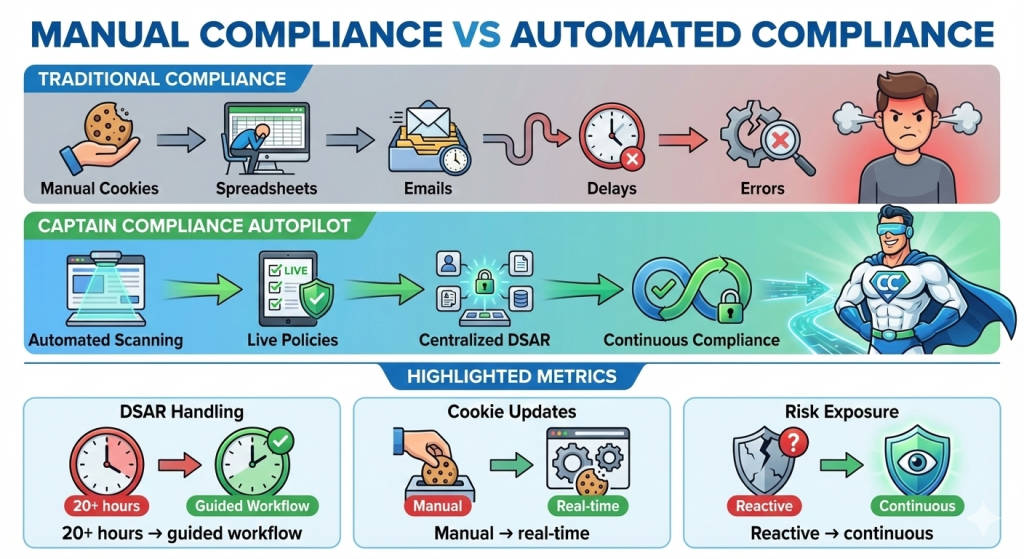
Privacy moves too fast to be managed manually. The core value of Captain Compliance lies in automation that replaces reactive compliance with continuous execution.
Automated Cookie Scanning and Policy Updates
Captain Compliance goes beyond basic cookie detection. Its scanner:
- Identifies and categorizes cookies automatically
- Updates dynamic privacy policies in real time
- Flags heavily litigated pixels, scripts, and tracking technologies
This ensures compliance evolves alongside digital assets without requiring manual intervention.
DSAR Command Center
Data Subject Access Requests are one of the most operationally intensive aspects of privacy compliance. Traditional handling can consume more than twenty hours per request.
Captain Compliance automates request intake, identity verification, data discovery, and fulfillment. What was once a multi-day process is reduced to a guided workflow that scales across the organization.
Enterprise Power Without Enterprise Pricing
The term enterprise-grade is often used loosely. Captain Compliance defines it through three clear pillars.
Scalability
The platform supports unlimited domains and millions of page views, allowing organizations to scale without performance or governance gaps.
Customization
Consent Management Platforms are fully customizable and brand-aligned, ensuring that compliance layers feel native and do not disrupt the user experience.
Security Infrastructure
Captain Compliance supports encryption at rest, on-premise deployment options, and private AI models using GPT-OSS so sensitive data never leaves the organization. As of today, it remains the only on-premise data privacy solution available at this price tier.
Support as a Product Feature: The Hero Model
One of the most common frustrations with legacy SaaS platforms is slow, ticket-driven support.
Captain Compliance treats support as a core product feature. Every customer is assigned a Dedicated Privacy Hero who assists with implementation, ongoing guidance, and immediate issue resolution.
The goal is not compliance this quarter. The goal is compliance this week, with responses measured in hours rather than weeks.
Why Captain Compliance Wins
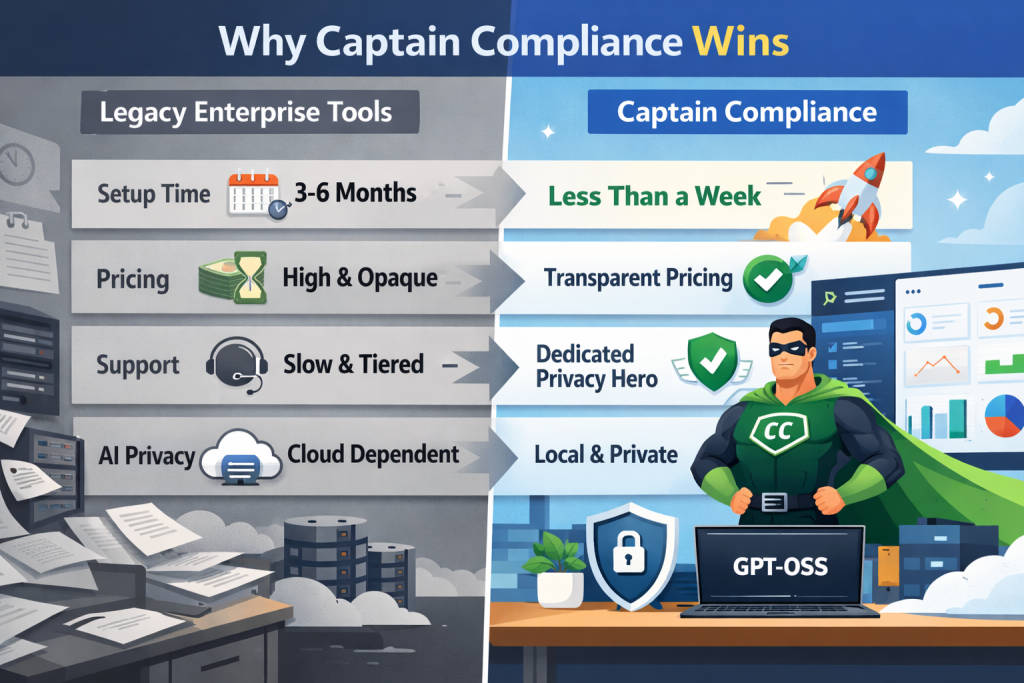
| Feature | Legacy Enterprise Tools | Captain Compliance |
| Setup Time | Three to six months | Less than a week |
| Pricing | Opaque with high entry cost | Transparent mid-market pricing |
| Support | Tiered and slow | Dedicated Privacy Hero |
| AI Privacy | Cloud-dependent | Local and private using GPT-OSS |
Beyond Cookies: AI Governance and Data Privacy in 2026
As privacy compliance matures, its center of gravity is shifting. The focus is moving from websites and cookie banners to AI systems that operationalize personal data.
By 2026, artificial intelligence is no longer experimental. It powers personalization, analytics, fraud detection, healthcare workflows, and automated decision-making across modern enterprises.
Regulators are responding by shifting attention from ethical intent to operational governance. Consent management, transparency, data subject rights, and vendor accountability now define AI compliance.
SaaSworthy buyer trends show sustained growth in searches for AI governance software, AI data privacy compliance, and consent management platforms. Parallel discussions on Reddit among privacy leaders and SaaS founders reinforce a consistent lesson.
AI systems rarely fail compliance because of model design. They fail because data governance is weak.
TL;DR: AI Governance and Data Privacy in 2026
What It Is
AI governance in 2026 focuses on ensuring AI systems lawfully collect, process, and share personal data under GDPR, the EU AI Act, CPRA, and HIPAA. The emphasis is on consent management, data subject rights, and third-party risk.
Why It Is Critical
Most regulatory violations stem from weak data governance rather than AI architecture. Without scalable privacy controls, organizations face fines, operational disruption, and loss of buyer trust.
Core Components
Key components include privacy impact assessments such as DPIAs and LIAs, compliant consent and cookie management, DSAR handling for AI workflows, third-party risk assessments, and continuous privacy monitoring.
Captain Compliance’s Role
Captain Compliance operationalizes AI governance through automated consent and cookie compliance, centralized DSAR workflows, structured vendor risk assessments, and ongoing privacy oversight.
Business Value
Organizations benefit from reduced regulatory exposure, faster compliance execution, lower operating costs, increased buyer confidence, and a scalable foundation for AI-driven growth.
The AI Governance and Data Privacy Regulatory Landscape
AI governance in 2026 is shaped by overlapping regulations:
- The EU AI Act introduces risk-based obligations for AI systems
- GDPR governs lawful data processing, consent, profiling, and automated decision-making
- CPRA strengthens consumer rights related to automated profiling
- HIPAA applies when AI systems process protected health information
Buyers increasingly evaluate AI solutions based on privacy readiness and compliance maturity rather than innovation alone.
Captain Compliance helps organizations align AI use cases with jurisdiction-specific consent and data processing requirements, reducing regulatory ambiguity.
AI Risk Classification and Privacy Impact Exposure
Under the EU AI Act, AI systems are categorized by risk. Privacy exposure increases when systems:
- Process personal or sensitive data
- Enable profiling or behavioral analysis
- Make automated decisions affecting individuals
- Depend on third-party datasets or models
These scenarios often require DPIAs and LIAs. Reddit discussions consistently show that organizations underestimate AI privacy risk during early deployment stages.
Captain Compliance supports structured privacy assessments tied to data usage and vendor involvement, helping teams identify risk early and reduce post-deployment remediation.
Consent Management and Cookie Compliance for AI Systems
AI-driven digital experiences rely heavily on consent-based data collection.
Under GDPR and CPRA, consent must be explicit, revocable, and properly documented. Fragmented consent tooling increases compliance risk and operational complexity.
Captain Compliance centralizes consent records, automates cookie compliance, and ensures AI systems respect user preferences across regions and touchpoints.
Data Subject Rights and DSAR Compliance in AI Workflows
AI complicates DSAR handling because personal data may exist across production systems, training datasets, and third-party platforms.
Organizations are still required to support access, deletion, correction, and opt-out rights. Manual DSAR workflows frequently fail at scale.
Captain Compliance centralizes DSAR intake, tracking, and response workflows, reducing delays and improving accuracy in complex AI environments.
Third-Party and Vendor Risk Management for AI
AI ecosystems rely heavily on vendors for models, data, APIs, and infrastructure. Each vendor introduces additional compliance risk.
SaaSworthy data shows buyers increasingly demand vendor transparency, while Reddit discussions frequently highlight exposure from unapproved AI tools.
Captain Compliance streamlines third-party risk assessments and supports continuous vendor monitoring to reduce compliance gaps.
Continuous AI Privacy Compliance
AI systems evolve continuously, making static compliance programs ineffective.
High-performing organizations adopt continuous privacy monitoring supported by centralized governance. Captain Compliance enables ongoing reassessments and reduces reliance on manual processes.
AI Governance and Data Privacy Statistics for 2026
- Over 70 % of enterprise AI systems process personal data
- 40 % of GDPR fines stem from consent and data processing failures
- More than 60 % of DSAR delays are caused by manual workflows
- Third-party vendors contribute to over 55 % of data breaches
- Automated privacy platforms reduce compliance costs by up to 45 %
Frequently Asked Questions
1. What is AI governance from a data privacy perspective?
AI governance ensures AI systems comply with privacy laws by controlling consent, lawful data processing, data subject rights, and vendor risk.
2. How does the EU AI Act impact data privacy compliance?
It introduces AI-specific obligations while reinforcing GDPR-compliant data processing.
3. When are DPIAs required for AI systems?
When AI systems process personal data in high-risk ways such as profiling or automated decision-making.
4. Why is consent management critical for AI compliance?
Without valid consent, AI-driven data processing may violate GDPR and CPRA regardless of model performance.
5. How do DSARs apply to AI systems?
Organizations must fulfill data subject rights even when data is embedded in AI workflows.
6. Why is third-party risk management essential for AI governance?
Most AI systems rely on external vendors, and regulators increasingly hold organizations accountable for vendor failures.
7. How does Captain Compliance support AI governance?
Captain Compliance automates consent and cookie compliance, centralizes DSAR workflows, simplifies vendor risk assessments, and supports continuous privacy compliance.
Final Takeaway
In 2026, AI governance is fundamentally a data privacy challenge.
SaaSworthy insights show that buyers reward organizations that demonstrate privacy maturity. Reddit discussions confirm that compliance failures most often stem from weak consent management, DSAR handling, and vendor oversight.
Organizations that embed privacy-first controls into AI governance reduce regulatory risk and build long-term trust. Captain Compliance enables this shift by turning complex AI privacy requirements into operational, scalable compliance.
