

AI search visibility tracking measures how often and how accurately your brand appears, gets recommended, or receives citations in AI-generated answers. Businesses can track this visibility across platforms like ChatGPT, Google AI Overviews, Gemini, Perplexity, and Claude by monitoring brand mentions, citations, recommendation frequency, prompt coverage, and share of voice.
This shift creates a new visibility challenge for businesses. Ranking well on Google is no longer enough. Brands must also appear in AI-generated answers when potential customers research solutions, compare alternatives, and evaluate products or services.
This guide explains how AI Search Visibility works, why it matters, the key metrics to track, the best AI Search Visibility Tracking tools, and proven strategies to improve your brand visibility across AI search platforms.
KEY TAKEAWAYS
- AI Search Visibility Tracking measures how often brands appear, get recommended, or receive citations in AI-generated answers across platforms.
- Brands can improve AI search visibility by creating useful content, building authority, earning trusted mentions, and updating information regularly.
- Top AI Search Visibility Tracking tools include HubSpot AEO, Profound, Peec AI, SE Ranking, Otterly.ai, Scrunch AI, and Goodie AI.
How AI Search Works
AI search uses Retrieval-Augmented Generation (RAG), Large Language Models (LLMs), and ranking systems to retrieve relevant information and generate direct answers based on user queries.
For example, when a user asks, “What is the best CRM software for startups?”, the AI systems analyze the query intent, retrieve relevant information from trusted sources, evaluate available sources, and generate a response based on the selected context.
The process helps AI platforms determine which brands, sources, and information appear in AI-generated answers.
How AI Models Choose Brands
While AI platforms do not fully disclose how brands and sources are selected, several factors can influence whether a brand is surfaced in AI-generated answers, including relevance, information quality, source authority, and consistency across the web. Important signals to consider include:
- Brand Relevance: AI systems evaluate whether a brand directly matches the user’s intent. Clear product information, industry-specific content, and relevant use cases help AI understand when to recommend a brand.
- Information Sources: AI platforms use information from websites, publications, reviews, and other trusted sources. Consistent mentions across reliable sources improve brand recognition.
- Content Quality and Accuracy: AI models prefer accurate, detailed, and updated information. Regularly maintained product pages, guides, and documentation help AI platforms provide better recommendations.
- Authority and Trust Signals: Industry mentions, expert references, citations, and third-party coverage help AI systems assess whether a brand is credible and worth mentioning.
How AI Search Differs Across Platforms
Each AI search platform uses different models, data sources, and retrieval methods, which directly influence how brands appear in AI-generated answers.
Let’s compare how leading AI platforms generate answers.
- ChatGPT: Uses OpenAI language models with web search capabilities to generate responses. Brands gain visibility when they have clear, accessible, and frequently referenced content.
- Google AI Overviews: Uses Google’s search index to generate AI summaries. Brands with strong SEO, E-E-A-T signals, and structured data have better chances of appearing.
- Gemini: Combines Google AI models with search data and Knowledge Graph information to provide relevant responses. Fresh, structured, and accurate content improves brand visibility.
- Perplexity: Works as an answer engine that retrieves real-time web information and provides source citations. Brands with authoritative content and trusted references gain visibility.
- Claude: Focuses on detailed analysis and long-context responses. Brands with accurate, comprehensive, and technical content are more likely to be referenced.
What Is AI Search Visibility?
AI Search Visibility measures how often a brand appears, gets recommended, or receives citations in AI-generated answers across platforms such as ChatGPT, Google AI Overviews, Gemini, Perplexity, and Claude.
Key Signals That Impact AI Search Visibility
AI Search Visibility depends on several signals that determine how often and how prominently your brand appears in AI-generated answers.
A. Brand Mentions
A brand mention occurs when an AI response includes your company name, product, or service. For example, if a user asks:
“What are the best project management tools?”
and the AI response includes your software, your brand has gained visibility for that topic.
B. AI Citations
Mentions and citations are different. A mention only includes your brand name. A citation refers to a source that supports the information.
For example, an AI assistant may recommend your software and cite your product page, customer review, or industry article.
Citations are valuable because they show which sources influence AI responses.
C. Recommendation Frequency
A single appearance does not indicate strong visibility. A stronger measurement is how often your brand appears across different buying-related prompts.
For example, a CRM company appearing in queries such as:
- Best CRM software
- CRM for startups
- CRM automation tools
- Salesforce alternatives
has broader visibility than a brand appearing only once.
D. Sentiment and Positioning
AI visibility is not only about appearing. It also matters how AI describes your brand. AI may position a company as:
- Enterprise-focused.
- Affordable.
- Easy to use.
- Suitable for startups.
- Strong in customer support.
Tracking this positioning helps brands understand how AI systems perceive them.
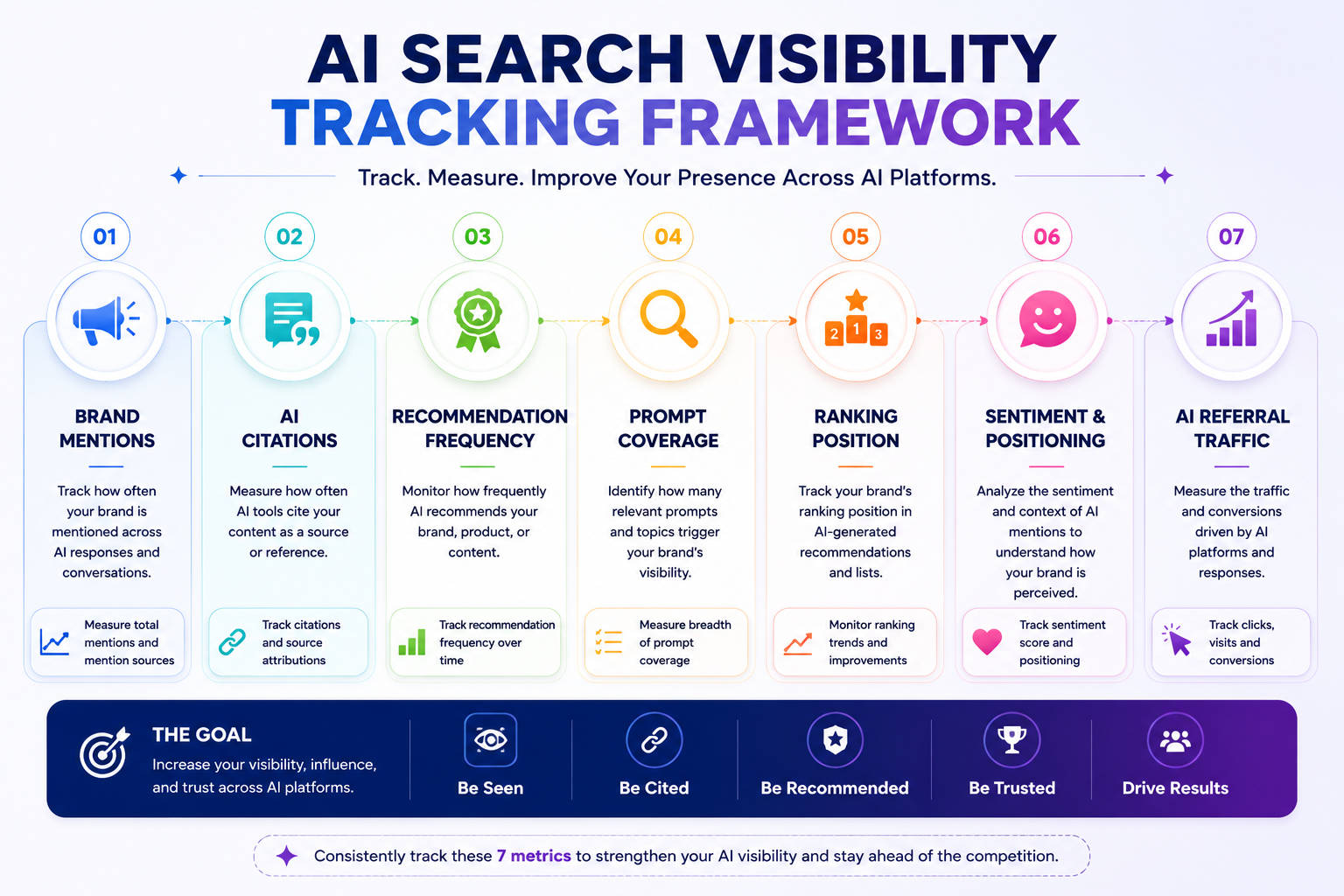
Pro Tip: A brand can appear frequently in AI answers but still lose opportunities if the positioning is inaccurate. Monitor descriptions and improve supporting content.
AI Search Visibility vs Traditional SEO
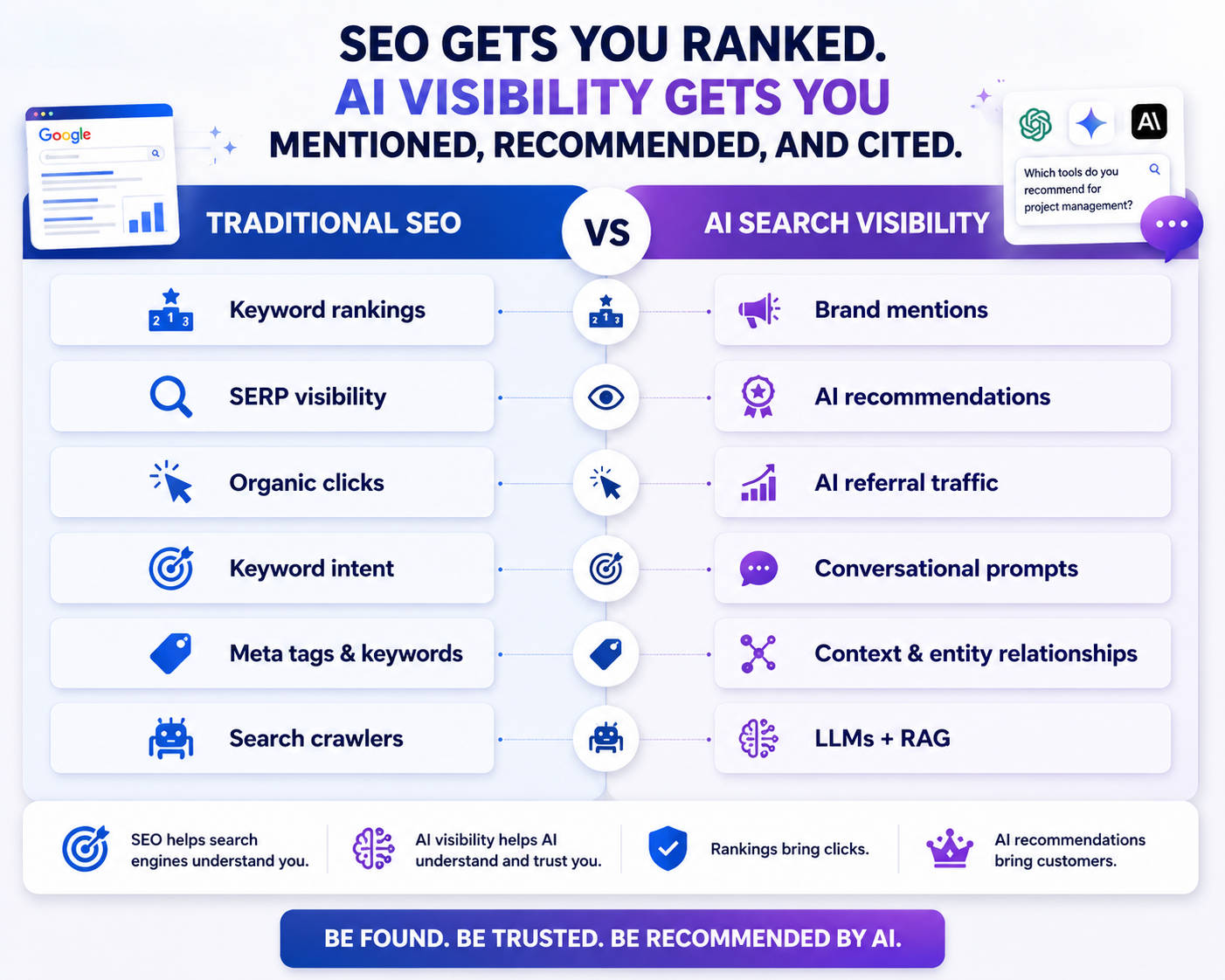
Traditional SEO focuses on search rankings and keyword performance, while AI search visibility tracks brand mentions, citations, and recommendations in AI-generated answers. The table below compares both approaches.
| Traditional SEO vs AI Search Visibility: Key Differences | ||
| Feature | Traditional SEO | AI Search Visibility |
| Primary Goal | Rank on Page 1 of Search Engine Result Pages (SERPs). | Get cited as a trusted source in AI-generated answers. |
| Core Metric | Organic clicks, impressions, and keyword rankings. | Brand mentions, sentiment, and prompt inclusion rate. |
| User Intent Focus | Specific keyword queries (e.g., “best CRM software”) | Conversational, multi-step prompts (e.g., “compare top CRMs for startups”) |
| Content Optimization | Keyword density, meta tags, and structured headers. | Contextual depth, entity relationships, and clear data structures. |
| Discovery Mechanism | Web crawlers indexing static page content. | LLMs parsing context, retrieval-augmented generation (RAG), and data training sets. |
Why AI Search Visibility Tracking Matters
AI platforms are becoming an important channel for product discovery, research, and purchase decisions. Adobe research found that AI-driven traffic to retail websites increased by 4,700% year over year in 2025. This shows the growing impact of AI on customer journeys.
As users rely more on AI-generated answers, businesses need to know whether their brand appears, how it is positioned, and which competitors gain visibility. Without AI Search Visibility Tracking, identifying these patterns becomes difficult.
AI search visibility tracking and AI brand monitoring tools help businesses measure:
- Brand mentions and recommendations.
- Competitor visibility across key queries.
- Sources influencing AI-generated answers.
- Prompts driving brand visibility.
- Visibility changes over time.
These insights help businesses identify gaps, improve content strategies, and understand their brand presence across AI search platforms.
Common Challenges in Measuring AI Visibility
Measuring AI visibility helps brands understand their presence in AI-generated responses, but tracking it comes with a set of challenges, outlined below:
- Changing AI Responses: AI answers can vary based on user prompts, location, conversation history, and model updates. This makes consistent tracking difficult.
- Limited Data Transparency: AI platforms do not fully disclose how they select sources, rank recommendations, or generate responses. Businesses need AI Search Visibility Tracking tools to identify visibility patterns.
- Tracking Multiple Platforms: ChatGPT, Gemini, Google AI Overviews, Perplexity, and Claude use different data sources and models. This requires cross-platform monitoring.
- Measuring Brand Context: A brand mention alone is not enough. Businesses must analyze how AI describes their products, services, and expertise.
- Identifying Citation Sources: AI citation tracking helps businesses understand which pages and external sources influence AI-generated recommendations.
Where Can Your Brand Appear in AI Search?
AI platforms can introduce your brand as a recommendation, comparison option, or trusted source. Here are the key areas where your brand can appear in AI search results.
A. Direct Recommendations
One of the most valuable AI visibility opportunities is appearing in direct recommendations. Users often ask AI assistants to suggest the best solution for a specific requirement.
For example:
“What is the best HR software for a company with 500 employees?”
If your brand appears in the response, it gets visibility at a stage where the user is actively evaluating options.
B. Product Comparisons
Many buyers use AI platforms to compare products before making a decision. Queries such as:
- Salesforce vs HubSpot
- Shopify vs WooCommerce
- Slack vs Microsoft Teams
help users understand features, pricing, and suitability.
Brands that appear in these comparisons can influence users who already have strong purchase intent.
C. Buying Guides
AI assistants are increasingly used to research and compare buying options. In fact, 39% of US consumers have used generative AI for shopping in 2025. Users ask questions based on their specific needs, such as:
“Which cybersecurity platform is suitable for healthcare companies?”
AI responses may recommend solutions based on features, industry use cases, and online reputation.
D. Source Citations
AI platforms often support responses with citations from websites, research reports, documentation, and industry publications. When your content is cited, it not only improves visibility but also builds trust with users.
E. Follow-Up Conversations
Unlike traditional search, AI conversations continue beyond the first query. Users may ask follow-up questions about pricing, features, alternatives, or use cases.
Brands that appear consistently throughout these conversations have more opportunities to stay visible during the decision-making process.
How to Track Your Brand’s Visibility in AI Search
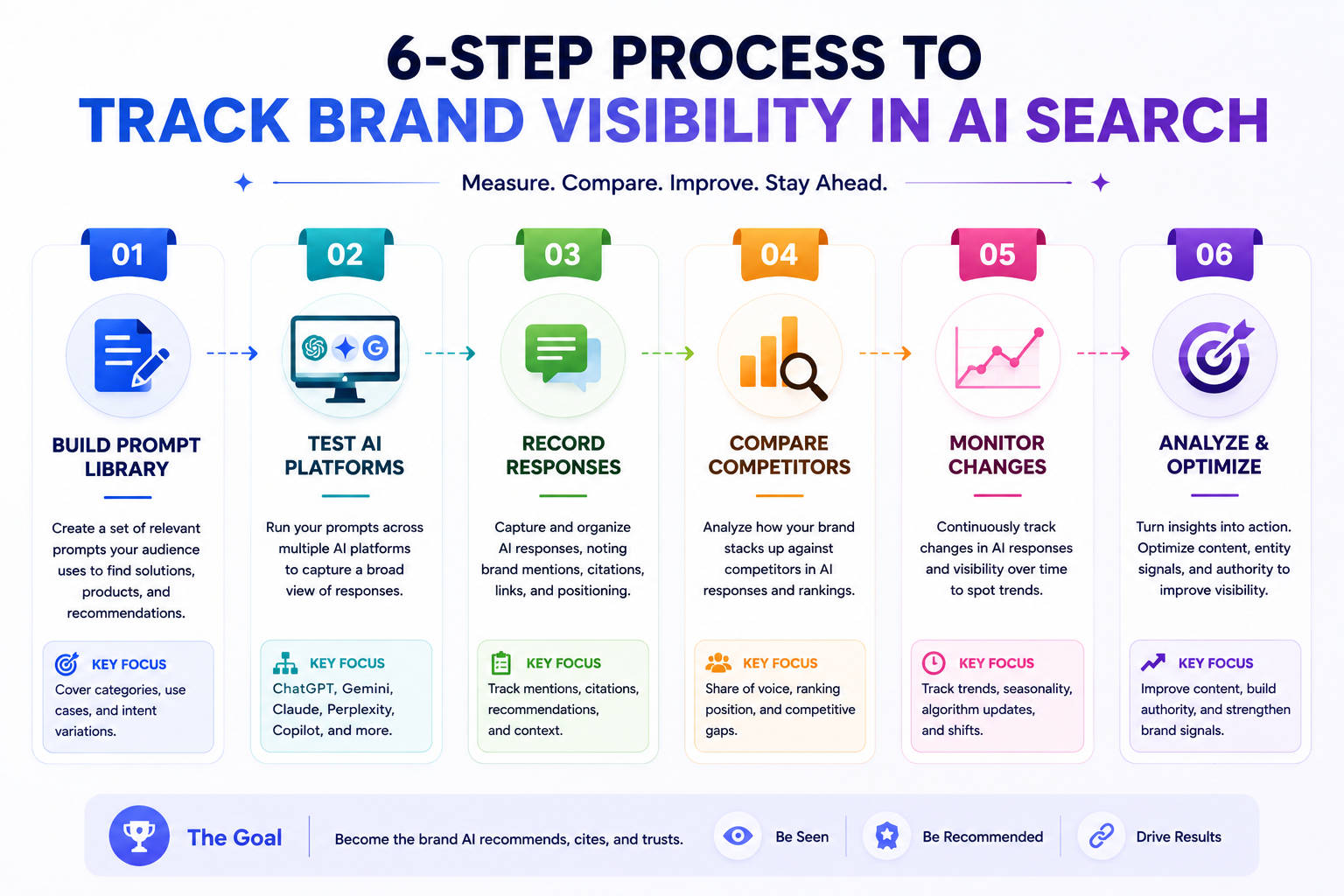
Tracking AI Search Visibility requires a consistent process to measure brand mentions, citations, recommendations, and competitor presence. Below are the key steps to track your AI visibility.
Step 1: Create a Priority Prompt Library
Start by building a list of questions your customers are likely to ask AI platforms.
Include different search intents, such as informational queries, commercial searches, product comparisons, alternatives, pricing questions, and best-of recommendations.
For example, a cybersecurity company may track prompts like:
“What is endpoint security?”
“Best endpoint protection software for enterprises”
“CrowdStrike alternatives”
Using the same prompt library regularly makes performance comparisons more accurate.
Step 2: Test Across Multiple AI Platforms
Run your prompts across ChatGPT, Google AI Overviews, Gemini, Perplexity, and Claude. Each platform may provide different recommendations based on its data sources and response systems.
Step 3: Record AI Responses
Track key visibility signals, including:
- Brand mentions and recommendations
- Competitor presence
- AI citation sources
- Recommendation position
- Sentiment and brand positioning
This data helps identify how AI platforms perceive your brand.
Step 4: Compare Against Competitors
AI visibility is relative. Compare your performance with competitors to understand which brands dominate important queries, receive more citations, and appear more frequently in recommendations.
Step 5: Monitor Changes Over Time
AI responses evolve as models update and new information becomes available. Regular monitoring helps identify changes in mentions, citations, competitor visibility, and long-term AI search trends.
Step 6: Analyze and Optimize
Use tracking insights to identify content gaps, improve existing pages, and publish new content for high-value prompts.
Manual vs Automated AI Search Visibility Tracking
Tracking your brand’s presence in AI search can be done manually or through dedicated AI Search Visibility Tracking tools, depending on your business needs.
Let’s understand how both methods work and when each approach makes sense.
| Manual vs Automated AI Search Visibility Tracking | ||
| Factor | Manual Tracking | Automated Tracking |
| Prompt Monitoring | Suitable for smaller prompt sets (10-30 queries). | Supports large prompt libraries (hundreds of prompts). |
| AI Platform Testing | Requires separate manual checks. | Tracks multiple AI engines through a centralized dashboard. |
| Visibility Tracking | Spreadsheet-based monitoring. | Dashboard-based reporting. |
| Competitor Analysis | Requires manual comparison. | Provides automated benchmarking. |
| Historical Trends | Limited tracking capability. | Tracks changes over time. |
A. Manual AI Search Visibility Tracking
Manual tracking works well for businesses with a smaller set of prompts. It involves creating a prompt library, testing queries across AI platforms, and recording responses manually.
You can track important visibility signals such as:
- Brand mentions and recommendations
- Competitor appearances
- AI citation sources
- Recommendation position
- Sentiment and brand positioning
However, manual tracking becomes difficult as prompts increase and requires more effort to monitor multiple AI platforms.
B. Automated AI Search Visibility Tracking
Automated AI brand monitoring tools help businesses track AI visibility at scale by analyzing responses, competitor presence, citations, and recommendation trends across platforms.
They help monitor:
- Brand mentions and citation frequency.
- Competitor Share of Voice.
- Recommendation trends
- Prompt-level visibility changes.
- Visibility trends over time.
Manual tracking works for initial AI visibility measurement, while automated AI Search Visibility Tracking tools are better for managing large prompt sets across multiple AI platforms.
Key Metrics to Measure AI Search Visibility
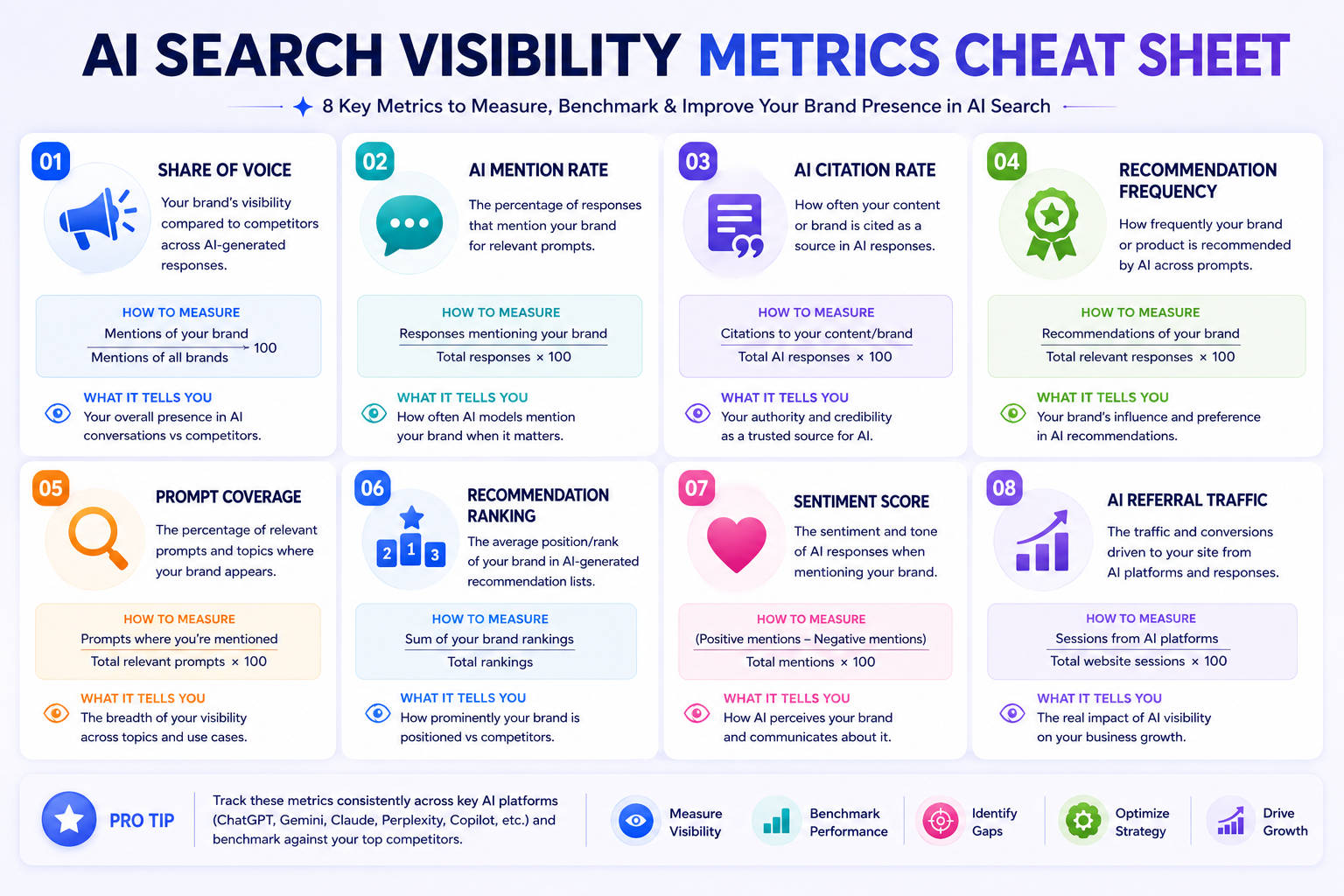
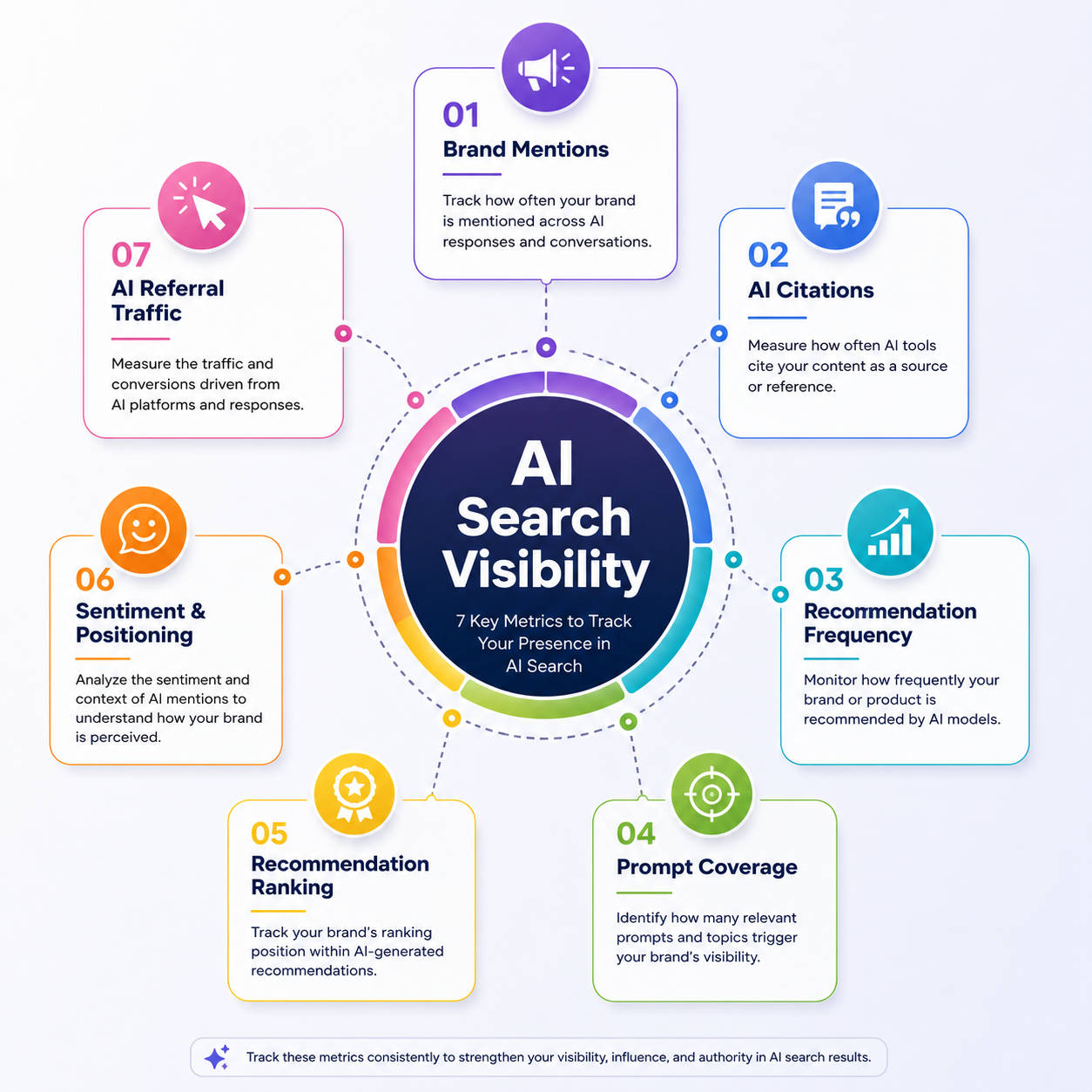
Measuring AI Search Visibility requires tracking the right performance signals. Here are the important metrics that show your brand presence in AI search.
1. Share of Voice (SoV)
Share of Voice measures your brand’s visibility compared with competitors across tracked AI prompts.
Formula: (Brand Mentions ÷ Total Brand Mentions Across All Brands) × 100
For example, if your brand appears in 200 out of 500 tracked recommendations, your Share of Voice shows your position compared with other brands.
2. AI Mention Rate
AI Mention Rate measures the percentage of prompts where AI platforms mention your brand.
Formula: (Prompts With Brand Mentions ÷ Total Prompts Tracked) × 100
For example, if your brand appears in 80 out of 200 tracked prompts, your AI Mention Rate is 40%.
3. AI Citation Rate
AI Citation Rate measures how often AI platforms reference your website or other sources associated with your brand.
Formula: (AI Responses With Brand Citations ÷ Total AI Responses Tracked) × 100
A higher citation rate indicates that AI systems consider your content a valuable source.
4. Recommendation Frequency
Recommendation Frequency measures how often AI platforms actively suggest your brand as a suitable option.
This metric shows whether your brand influences purchase decisions, not just appears in responses.
5. Prompt Coverage
Prompt Coverage measures the range of queries where your brand appears, including informational, commercial, comparison, and alternative searches. Higher prompt coverage indicates stronger visibility across different user intents.
6. AI Recommendation Ranking
AI Recommendation Ranking tracks where your brand appears when AI provides multiple recommendations.
Monitoring this metric helps identify whether your brand is appearing earlier or later in AI-generated suggestions.
7. Sentiment Score
Sentiment Score measures how AI platforms describe your brand. It tracks whether mentions are positive, neutral, or negative.
For example, AI may position your brand as enterprise-focused, affordable, easy to use, or feature-rich.
8. AI Referral Traffic
AI Referral Traffic measures visitors coming to your website from AI platforms.
Formula: (AI Platform Visitors ÷ Total Website Visitors) × 100
This metric connects AI visibility with actual website engagement and helps measure the business impact of AI-generated recommendations.
Pro Tip: Track the same set of customer prompts regularly across AI platforms. Consistent monitoring helps identify visibility changes and competitor movements.
Best AI Search Visibility Tracking Tools
With AI search becoming a key brand discovery channel, businesses need AI Search Visibility Tracking tools to monitor mentions, citations, recommendations, and competitor visibility.
Since tracking needs vary, consider these factors before choosing a tool:
- Support for leading AI platforms like ChatGPT, Gemini, and Perplexity.
- Ability to track brand mentions, citations, recommendations, and competitors.
- Support for custom prompts based on user intent.
- Detailed reports to monitor visibility trends and performance.
If you want to skip the evaluation process, here are the top AI Search Visibility Tracking tools to consider:
| Top Tools to Track AI Search Visibility | |||||
| Tool | AI Mentions | Citations | Competitor Tracking | Multiple AI Engines | Reporting |
| HubSpot AEO | ✓ | ✓ | ✓ | ✓ | ✓ |
| Profound | ✓ | ✓ | ✓ | ✓ | ✓ |
| Peec AI | ✓ | ✓ | ✓ | ✓ | ✓ |
| SE Ranking | ✓ | ✓ | ✓ | Limited | ✓ |
| Otterly.ai | ✓ | ✓ | ✓ | ✓ | ✓ |
| Scrunch AI | ✓ | ✓ | ✓ | ✓ | ✓ |
| Goodie AI | ✓ | ✓ | ✓ | Limited | ✓ |
| Waikay | ✓ | ✓ | ✓ | ✓ | ✓ |
Note: Feature availability and model coverage are based on current vendor information and may change over time.
A. HubSpot AEO
HubSpot’s AEO tools help marketing teams understand how their brand appears across AI search experiences and identify opportunities to improve visibility. Because these insights can be used alongside HubSpot’s existing CRM, content, and marketing data, teams can connect AI search visibility with their broader content and customer acquisition strategy.
Best for: HubSpot users, content teams, and B2B companies.
B. Profound
Profound is one of the AI Search Visibility Tracking tools that monitors brand mentions, citations, competitors, and Share of Voice across leading AI platforms. It also helps teams analyze how their brand is positioned and recommended in AI-generated responses.
Best for: Enterprise teams, AI visibility monitoring, and competitive analysis.
C. Peec AI
Peec AI helps businesses analyze their presence in AI search results by tracking prompts, brand mentions, citations, and competitor visibility. It provides insights into how often brands appear across AI-generated answers and recommendations.
Best for: SaaS companies, marketing teams, and growing businesses.
D. SE Ranking
SE Ranking combines traditional SEO monitoring with AI search visibility tracking features. It helps businesses analyze AI-generated mentions, compare competitors, and understand changes in their search presence across evolving search experiences.
Best for: SEO professionals, agencies, and content teams.
E. Otterly.ai
Otterly.ai is one of the AI Search Visibility Tracking tools that monitors brand mentions, citations, and competitor performance across AI platforms. It provides visibility insights that help brands understand how they appear in AI-generated recommendations.
Best for: AI marketing teams, agencies, and multi-query tracking.
How to Improve Your Brand’s Visibility in AI Search Results: Best Practices
Tracking AI visibility shows where your brand stands. The next step is improving the signals that influence AI recommendations.
- Create Answer-Focused Content: Publish content that answers user questions instead of targeting only keywords. Guides, FAQs, comparisons, and research articles help AI systems understand your content.
- Build Topical Authority: Cover related topics within your industry to show expertise. A broader content library gives AI platforms more context about your brand.
- Strengthen Brand Authority Across the Web: Build visibility beyond your website through trusted publications, reviews, and third-party mentions that influence AI evaluation.
- Publish Original Research: Create surveys, reports, and industry studies with unique insights. Original data increases the chances of earning citations from websites and AI platforms.
- Optimize Content Structure: Use clear headings, short paragraphs, direct answers, and structured formats to make content easier for users and AI systems to understand.
- Use Schema Markup: Add structured data such as Organization, Product, Article, FAQ, and Review schema to help search systems understand page context.
- Keep Important Content Updated: Regularly refresh statistics, product details, and examples to maintain accurate information that AI platforms can reference.
Expert Advice: AI visibility should not be measured only by brand mentions. A brand may appear frequently in AI-generated responses but still lose opportunities if the model’s context, positioning, or supporting data does not accurately represent its value proposition.
The Future of AI Search Visibility Tracking
AI Search Visibility Tracking will continue to evolve as AI platforms become a major source of brand discovery. Below are the key trends shaping how businesses will monitor AI visibility in the future.
A. Real-Time AI Visibility Monitoring
Businesses will increasingly use automated AI brand monitoring tools to track changes in brand mentions, recommendations, and citations across multiple AI platforms in real time.
B. Advanced Competitive Analysis
Future tracking solutions will provide deeper competitor insights by showing which brands appear most frequently, which sources influence AI recommendations, and where visibility gaps exist.
C. AI Citation Intelligence
AI citation tracking will become more important as businesses try to understand which content assets, reviews, and external sources contribute to AI recommendations.
D. Business Impact Measurement
AI visibility measurement will gradually connect with business outcomes such as website visits, leads, conversions, and revenue generated from AI-driven discovery.
E. Integration With SEO Strategies
AI visibility tracking and traditional SEO will work together as part of a broader search strategy. Businesses will need to optimize content not only for search rankings but also for AI understanding and recommendations.
The Bottom Line: AI search is still evolving, but one thing is clear– brand visibility will no longer depend only on traditional search rankings. Businesses that understand how AI systems discover, evaluate, and recommend brands will have a stronger position in the future of digital discovery.
We believe that AI search visibility tracking should become a regular part of brand monitoring, similar to SEO performance tracking. Companies that adapt early will be better prepared as customer journeys continue moving toward AI-driven recommendations.
Want to understand how your brand appears in AI search? Explore HubSpot’s AEO tools to track AI visibility, identify content opportunities, and see where your brand shows up in AI-generated answers.
FAQs
1. What is AI Search Visibility Tracking?
AI Search Visibility Tracking measures how often and how accurately AI platforms mention, cite, or recommend a brand across target user prompts.
2. How is AI Search Visibility different from SEO?
SEO tracks search engine rankings, organic traffic, and keyword positions. AI Search Visibility monitors brand mentions, source citations, and placement inside generated answers.
3. Which AI platforms should businesses monitor?
Businesses should monitor platforms such as ChatGPT, Google AI Overviews, Gemini, Perplexity, and Claude based on where their audience researches solutions.
4. What is the difference between AI mentions and AI citations?
An AI Mention names your brand inside an answer. An AI Citation links directly to an underlying source URL supporting that answer.
5. Is AI search visibility replacing SEO?
No. AI Search Visibility complements SEO. SEO measures rankings and traffic, while AI visibility tracks brand presence in AI-generated recommendations.
6. Which metrics are most important for AI visibility?
Key metrics for AI visibility tracking include Share of Voice, AI Mention Rate, Citation Rate, Recommendation Frequency, Prompt Coverage, and AI Referral Traffic.
7. Which AI brand monitoring tools can track AI citations and mentions?
Tools such as HubSpot AEO, Profound, Peec AI, SE Ranking, and Otterly.ai help track AI mentions, citations, competitor visibility, and trends.
8. How to track brand visibility in AI search?
To track brand visibility in AI search, create relevant prompts, test them across AI platforms, monitor brand mentions and citations, compare competitors, and analyze visibility trends over time.
9. How can businesses improve AI search visibility?
Businesses can improve AI search visibility by creating answer-focused content, building topical authority, earning trusted mentions, and keeping important information updated.
