

Data aids us in navigating the ambiguous future. It aids with our ability to recognize trends, arrive at wise conclusions, and foresee future events. Additionally, if there is ever a problem, the data is always blatant about it.
Data is problematic because there is simply too much of it, but dashboards are a great method to store it all.
They are made to assist you in managing and optimizing your performance on a single screen, enabling you to quickly make important adjustments and cut down on unnecessary spending. They can even be used to provide reports with measurable, palpable, and understandable data visualization for clients and stakeholders.
Here is what they are and how you can use them to reap the most benefits.
Table of Contents
What are Dashboards?
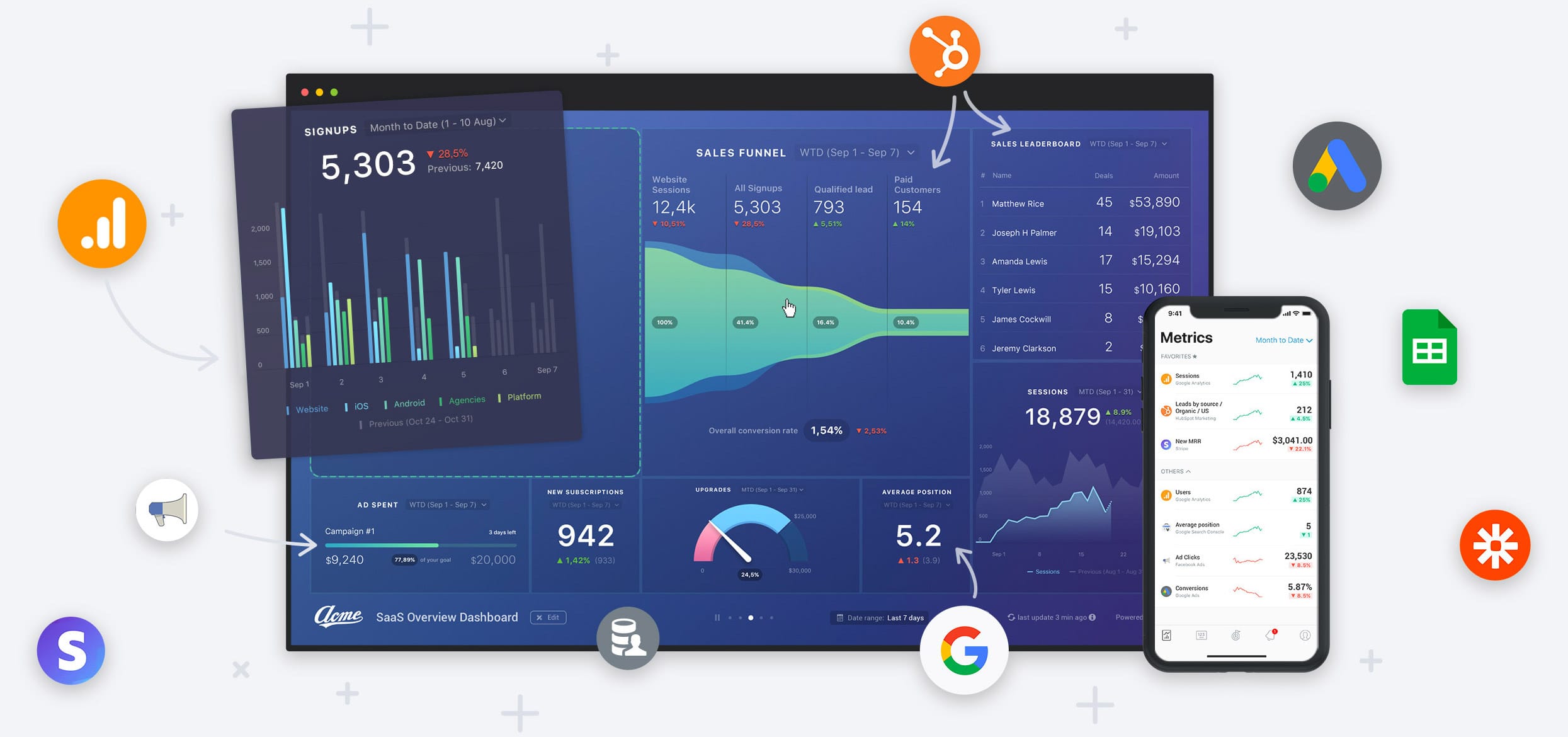
The word “dashboard,” which refers to the real-time information regarding how our cars are functioning, was first used by automobiles. It’s right there for you to see if something needs your attention or if your oil is getting low.
Similar to personal dashboards, business dashboards offer aggregate data that can help your business succeed as a whole. Data and analytics are crucial to digital transformation activities, according to 90\% of firms, and they are not mistaken.
Making a high-level dashboard your own and presenting the facts in a style that suits you is the secret to success. The user prefers to highlight the most crucial metrics on the left side of the screen, followed by the top-performing channels, campaigns, and pages at the bottom of the screen, as can be seen in the example above.
Operational dashboards are the most typical kind of dashboard, although you can also use:
- Analytical dashboards: They are typically more complex and require a deeper level of comprehension. They are packed with numbers and technical terms that you could only understand if you knew what you were looking for.
- Strategic dashboards: These are your best option if you want to share a dashboard with your entire organization or track long-term growth.
Analytical dashboards are typically more complex and require a deeper level of comprehension. They are packed with numbers and technical terms that you could only understand if you knew what you were looking for. Strategic dashboards are your best option if you want to share a dashboard with your entire organization or track long-term growth.
5 Ways a Dashboard Can Enhance Team Performance
1. It makes vital information easily available.
To track their performance data, your team frequently has to go through a number of tools, reports, or other people. However, a dashboard gives your team access to all of their important data in one location whenever they need it.
Additionally, a dashboard streamlines the data for your team and eliminates the need for analysis. For instance, your team can explore a maze of data using tools like Google Analytics. In contrast, a well-designed dashboard provides your team with the only set of numbers they actually need and does it in a manner that allows for quick comprehension.
Performance-wise, this allows them to focus their efforts on changing the data rather than arguing over their interpretation.
2. It concentrates their attention on crucial goals
Your staff may become sidetracked and overlook what is crucial when doing routine duties. By making any KPIs (key performance indicators) or significant and vital objectives fully accessible to your team, a dashboard prevents this. This enables them to concentrate on things that will genuinely have an impact. A dashboard also clarifies new goals to keep your team on track as priorities change.
3. They are motivated by it
Giving your staff specific goals offers them something to work toward. It motivates them to take ownership by demonstrating to them how they can impact the business. And this ought to stimulate their inner motivation and natural curiosity.
Additionally, most dashboards allow you to add leaderboards and identify top achievers. This is beneficial for sales teams in particular because they are frequently inspired by healthy rivalry and appreciation (extrinsic motivation).
4. It displays their effect
A dashboard makes it easy to see how fresh ideas are affecting your team’s efforts to reach its objectives. For instance, a marketing team might notice that a new ad campaign caused an increase in sign-ups.
5. It motivates them to act
The ultimate goal of a dashboard is to support your team in taking action to boost performance. But you really need TV dashboards to make this happen. These are displayed on a large screen in front of your team and provide real-time feedback on the state of affairs. Additionally, they make it impossible to overlook issues and possibilities.
Consider the scenario when your customer service department handles tickets. With a TV dashboard, they can quickly identify bottlenecks and address client inquiries before they spiral out of control. They might overlook the issue or catch it too late if they didn’t have a dashboard or had to constantly refresh one in one of their tabs.
How is a Dashboard made?
You’ll undoubtedly want to create your own dashboard now that you are aware of its advantages. Making one in Google Sheets is a simple and easy way to achieve this. Use specialized dashboard software instead, if you like. These make it really simple to compile information from all of your preferred tools, create an attractive dashboard that is easily understood at a glance, and share it with your team.
Who can use a Dashboard?
A dashboard is useful for almost all businesses. Multiple dashboards could be useful for larger organizations to create attainable aims and goals for each department.
Dashboards are beneficial if:
- You keep noticing irregularities in your current data.
- You lack the skills necessary to handle your data and make it valuable.
- You need better results but are baffled by your present output.
- You’re having trouble managing your data on many platforms.
- For better outcomes and a higher ROI, you must automate your workload.
- A dashboard might be the solution if your company regularly encounters these issues. If you work in a particular sector, it might be crucial to your success.
Conclusion
A dashboard for your team is always advantageous. Dashboards are the way to go to increase your team’s success since they keep everyone on the same page and make all data readily available and visible at any time.
