

If you want to be a project manager, you’ll probably have to go through an interview with a hiring team to see if you’re the best candidate for the job. It’s essential to be able to articulate both your technical and soft talents so that a hiring manager can trust your abilities. Preparing appropriately for the interview is an important part of succeeding in it. The top 10 project manager interview questions are discussed in this article, along with sample responses.
Table of Contents
Most Common Project Manager Interview Questions

To help you prepare, look over the following project manager interview questions:
Which project management approach do you prefer?
This question is asked to test your technical knowledge as well as your ability to adapt. Describe the methods you utilized.
A project management methodology is a set of concepts and practices that will assist you in organizing your projects and ensuring that they run smoothly. Project management is critical for companies and teams, but to be truly effective, you must ensure that your project management methodology is properly mapped to your team type, project, organization, and goals.
Example- For my past projects, I mainly used Waterfall. Waterfall enables me to produce quicker delivery cycles by allowing the client to inspect each level of development and provide constructive criticism. In my spare time, I’ve also researched the Lean project management methodology and attempted to incorporate some of it into my project management approach.
In the past, what project Management Software did you use?

Project Management Tools are the instruments that project managers need to assist a team or an individual in organizing their work. It is utilized to ensure that their initiatives and duties are completed successfully. Project management is not a simple process. It’s a complicated jumble of ideas that includes everything from strategy to people management to IT communications to data crunching. They’re used when they need to plan or schedule their projects’ tasks, identify key routes, track progress, and perform all of the other necessary chores for a smooth project cycle.
The project management tools allow you to plan, schedule, document, collaborate, and evaluate your projects. Provide a list of project management tools you’re familiar with, along with a brief description of their features.
Example- I’ve tried network diagrams, Gantt charts, PERT charts, Project Documentation, and logic networks as project management tools. In my leisure time, I’ve also studied the work and product breakdown structure, since I believe these tools will be useful in my future projects.
What is your strategy for dealing with scope creep?

The project scope refers to all of the tasks that must be completed in order for a project to be completed. A work breakdown structure (WBS) can assist you in identifying all of your project’s distinct tasks, activities, and deliverables. After that, you’ll need a scope statement, which is a project planning document in which you describe the project’s scope.
The project manager’s primary responsibility is to ensure that the project stays on budget and on schedule. Scope creep describes modifications that cause the team to fall short of their initial goals. Scope creep is when modifications to the project scope are made without the use of a control method such as change requests. These changes have an impact on the project’s schedule, budget, costs, and resource allocation, and they may jeopardize the achievement of milestones and objectives.
Your responses will enlighten the interviewer about your resource management skills.
Example- I have worked on a major project where the objectives were continually shifting in response to client feedback. To complete the project on time and on budget, I used strict time management and clear communication with the customer and management.
What is a project’s lifecycle?
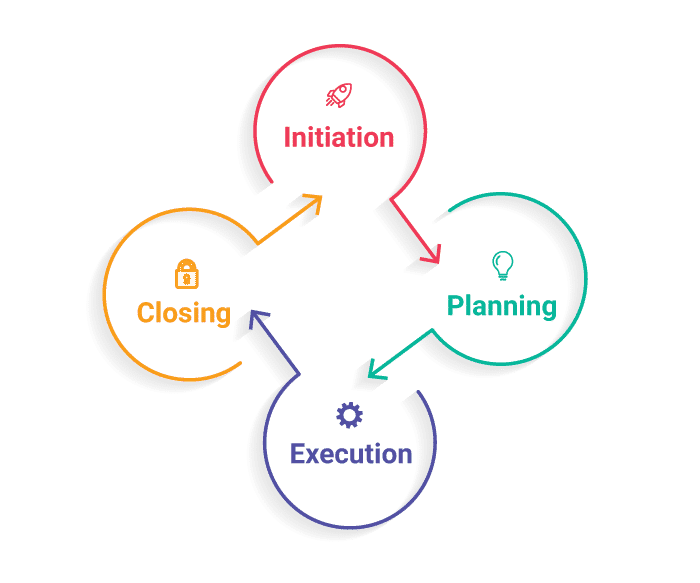
The project life cycle entails the actions that project managers must take in order to properly manage a project from beginning to end. Initiating, planning, executing, monitoring/controlling, and closing are the five phases of the project life cycle (also known as the 5 process groups). Each of these project phases is a collection of interconnected processes that must occur.
Example- The lifespan of a project involves five phases: initiation, planning, execution, monitoring and control, and closing.
What are your thoughts on the triple constraint triangle in project management?
Another technical question, in which the interviewer assesses your technical knowledge and how you apply it in your regular work. Explain the definition before demonstrating how you would use it in practice.
According to the triple constraint theory, every project will have three constraints: budget/cost, time, and scope. And these restrictions are intertwined. Any adjustment to one of the three limitations affects the other two. If you push back the deadline on your project by a week or two, your budget and scope limits may be impacted in a variety of ways, including:
- Because you “have more time,” the temptation to add functionality to the project is currently on hold (scope creep).
- Bringing in employees from other teams to assist with the project may result in a budget increase.
- If your team members are not directly associated with the areas that require more time, they may be reallocated. If they are too involved in another project, it may be tough to get them back.
Example- The triple constraint is a constraint model in which the sides of the constraint triangle are time, scope, and cost, with quality as the dominant topic. I use a triple constraint diagram for every project I manage to guarantee that it stays on schedule and within budget.
How are you going to prevent gold plating?

In project management, gold plating refers to when a team member or manager adds extra functionality not specified in the project scope to demonstrate their abilities. This question is asked by the interviewer to see how you deal with team members who don’t follow directions.
When the project team adds extra features that were not part of the original scope, usually as “freebies” for the client, this is known as gold plating. These are some of the probable factors:
- Going above and beyond: the project team believes that this will satisfy the client.
- Members of the squad want to showcase their abilities.
- Distracting attention away from flaws: an attempt to conceal flaws or errors.
Example- I’m always on the lookout for gold plating indicators. If I come across any additional functionality, I’ll speak with the team member personally. I’ll tell them not to add any new features without first gaining clearance from the client.
What kind of performance reports do you make use of?

In project communication management, performance reporting is essential. It entails gathering and disseminating project information to various stakeholders, as well as discussing project progress, resource use, and forecasting future development and status, as determined by the communication management plan. During the performance reporting process, the work outcomes of other processes are analyzed and integrated into performance reports. They’re usually presented in tabular or graphical formats, which might be text-based, visual (such as charts, graphs, or tables), or a combination of both.
It is your duty as a project manager to keep the client and management informed about the project’s status and development. The interviewer wants to know if you deliver regular reports to your clients and superiors.
Example- I use three different types of performance reports: progress, status, and forecast. The progress report focuses on the tasks that have been done, whereas the status report focuses on the discrepancies that have been discovered thus far.
Which method do you prefer: fast-tracking or crashing?
Project managers employ both fast-tracking and crashing strategies to reduce project duration without sacrificing quality or scope. Fast-tracking is a method of performing actions in parallel that would have been conducted sequentially under the original plan. To put it differently, fast-tracking a project involves working on all of the tasks at the same time rather than waiting for each element to be done separately. However, it can only be used if the actions in question can overlap.
When fast-tracking does not save enough time on the project schedule, the crash is the strategy to apply. This method allows for the addition of resources to the project at the lowest potential cost. To see how much compression can be obtained for the least amount of money, cost and schedule tradeoffs are examined. Crashing is also costly because the project’s resources are increased.
Here’s how you can respond to this question:
Example- It is dependent on the resources available. If the client is ready to pay a higher price, I will use the crashing process, which involves increasing resources for the project. I like fast-tracking when numerous things may be completed in tandem.
Describe the stages of a project from beginning to end
The easiest approach to answer this question is to give an example of a hypothetical project and describe the different phases. The interviewer is curious as to how you will approach each phase.
Example- Initiation, planning, execution, monitoring & control, and closing are the stages of a project. As the project manager, it is my obligation to ensure that my team efficiently completes each of these stages while staying under budget and on schedule.
Have you ever worked on a project that fell behind schedule?
Project managers are frequently confronted with challenges such as missing deadlines or going over budget. The interviewer is curious as to how you tackle these difficulties. To frame your response to this question, use the STAR method:
Example- I was working on a project where a client wanted to add a new feature. We’d have to miss the first deadline if we worked on this feature. I presented the client with various options after consulting with my colleagues. They might miss the first deadline and postpone the project’s launch with the new feature, or they could launch it on time and add the functionality later. The client agreed to stick to the original timeline and expressed gratitude for our taking the time to walk them through the options rather than simply delaying the project.
Additional Questions:
- How do you deal with team conflict?
- What will you do if one of your team members is underperforming?
- What are the three most important abilities for a project manager to be successful?
- What are your plans if a project runs late?
- Can you describe how you’ll handle projects from home while working remotely?
Conclusion
In this blog, we discussed the Project Manager Interview questions and how can you easily answer each one of those with a better understanding of the sample answers provided above for you.
