

OKRs or objectives and key results are an active goal-setting methodology to achieve goals through highly scalable results.
To simply define OKRs, one can think of them as intent statements against practical results. In other words, OKRs are used in the professional world to announce an organization’s targets publicly. OKRs help companies set targets as well as design their pathway.
Table of Contents
How does an OKR work?

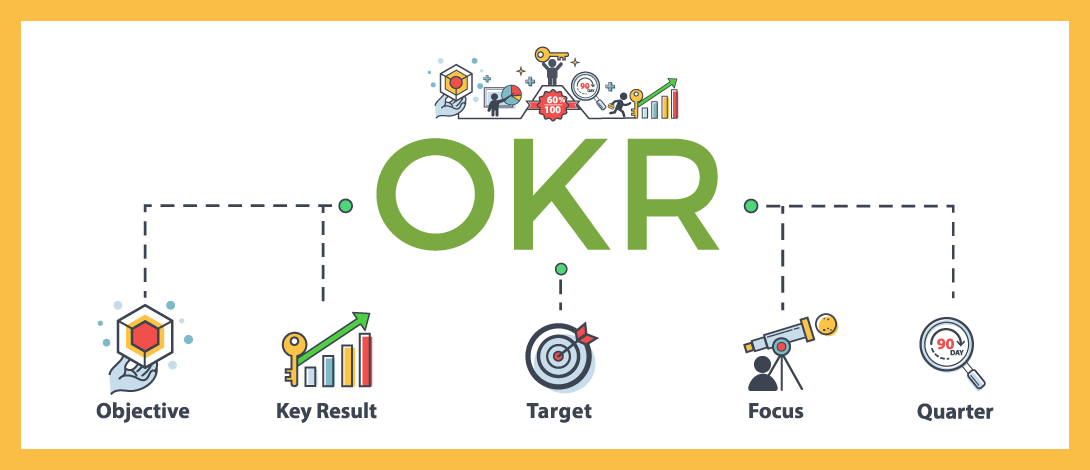
OKR is a conflation of two words: Objectives and Key Results.
Objectives are the part where a team or an individual sets reasonable goals. It is the ‘what is to be done’ part of an OKR. The characteristics of an ideal OKR objective are:
- Inspiring
- Practical
- Attainable
- Concrete
- Significant
- Strategic
- Qualitative
- Action oriented
On the other hand, key results are a scalable and verified set of statements that determine whether the targeted objective has succeeded or failed. The primary characteristic of a key result is that they are specific and have no gray areas. A key result will always have a black and white answer, and it will either represent success or failure.
Use of OKR in Operation Management
The operations sector is a crucial aspect of the business realm. It is the core of the entire business and essentially the supporting paddle of business as a whole set. The operations sector involves numerous tasks that fuel a lot of business processes. Therefore, in order to make the most out of your operation sector team, you need to implement the phenomenon of OKR.
OKRs enable team leaders to set preliminary goals for their projects. Implementing OKRs can benefit operations management in the following ways:
- Creating OKRs can simulate an environment that enables a sense of purpose in employees.
- OKRs help an organization keep track of projects, monitor progress, encourage employee engagement, maintain work alignment, and provide measurable results.
- When appropriately apple, it is a simple technique that, when appropriately apple,d raises work productivity, improves team communication, and raises a sense of commitment towards goals.
- OKRs are highly customizable. This means OKRs can be designed to fit a company’s needs.
How do OKRs work?
There are no hard and fast rules when it comes to writing an OKR. Generally, OKRs are a set of objectives measured against a quantifiable statement called key results.
OKR templates for operations can be generalized as:
*Objective* ___________(followed by these key results)
*key results*
__________
__________
__________
Objectives are preliminary goals that should be acted upon by the company. They are not bound by time. Key Results, on the other hand, are time-bound. Here is a brief illustration of how an OKR functions in the operations management department.
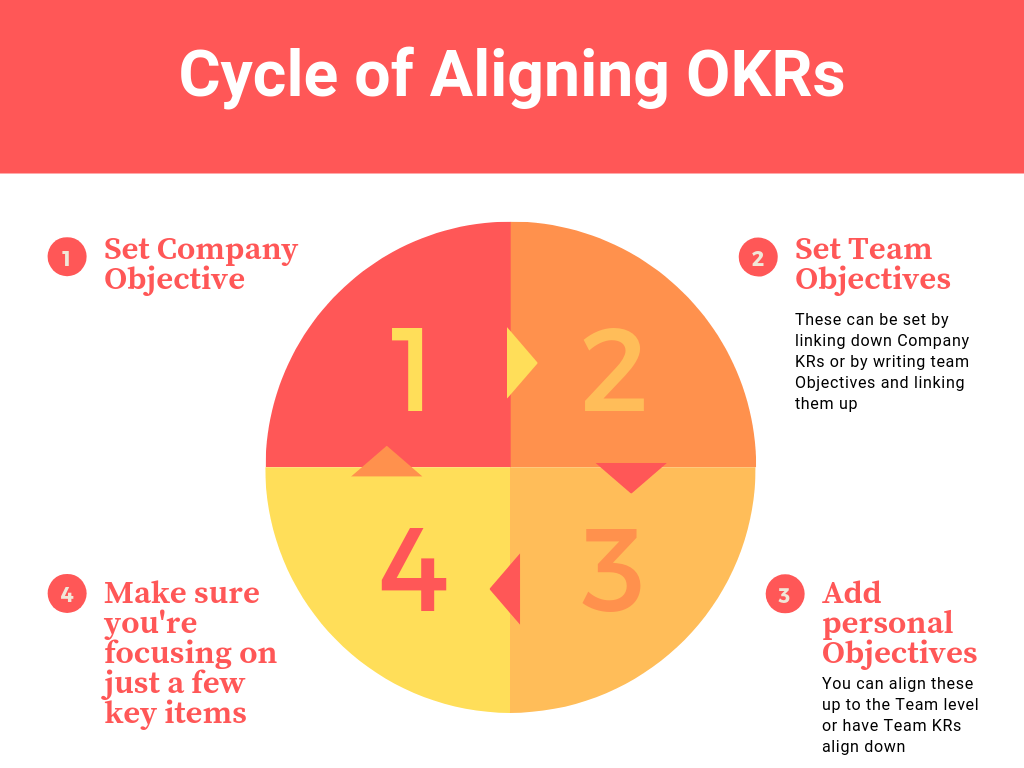
- Firstly, a set of objectives are collaboratively discussed, decided, and approved.
- These objectives are then worked upon by the team members.
- These objectives are considered as challenges, and every employee works towards them.
- On the other side, the progress of each objective or task is gauged and recorded by a contributor under the title key results.
- Timely monitoring (weekly or monthly) of the key results is conducted.
- Finally, at the concluding period of OKR, the key results are graded to call the project a success or failure.
Examples of OKR in Operations

Compiling OKRs is highly important for the overall performance of an organization. However, there are no preconceived notions about how to set them. As an individual or a team leader, you are independent to set actionable objectives and grade their key results.
Although if you puzzle over their format or content, here are a few OKR examples for operations that you can consider as a reference. These examples will help you understand the concept of compiling OKRs better.
- Objective 1: Establishing work excellence through company culture
Key Results:
- Plan company outings at least once a month.
- Augment the employee retention scores from 70 percent to 90 percent.
- Deliver an excellent score of 98 percent work satisfaction.
- Implement new ongoing processes.
- Carry out periodic work satisfaction surveys across the company.
- Objective 2: Develop a decent workplace
Key Results
- Launch new communication platforms to enable fast sharing of data and documents.
- Backing up all company and client-related data to the cloud.
- Implementation of the brand new online conference software.
- Cut off the office supply expense by 10 percent.
- Objective 3: Elevate company infrastructure level and the IT department by the quarter dates of 2021 (Q4 2021)
Key Results:
- IT technicians respond to customer support complaints within an hour.
- Share document files with the entire department.
- Creating a backup of the backup (alternate backups) just in case of emergencies.
- Cut off service downtime from 20 percent to 25 percent.
- Objective 4: Optimizing and maximizing work capacity and productivity of employees
Key Results:
- Expedite approval procedures as it undergoes various levels of a company.
- Ensuring that employees report to the meetings and conferences on time.
- Holding up quarterly training sessions for the admin staff.
- Ensuring that all employees have reached inbox zero by the end of the week.
- Objective 5: Efficiently managing internal documents
Key Results:
- Transferring all documents to new systems from the old file server.
- Asking each team to create an individual directory that structures their documents well and have them share it with a broader group.
- Launch and implement new platforms for document exchange.
- Objective 6: Increasing the overall efficiency of work procedures
Key Results:
- Increasing organizational productivity from 40 percent to 60 percent by the quarter dates of 2021 and 2022 (Q4 FY 2021-22).
- Implementing new technologies, tools, and resources by Q3 FY 2021-22.
- Hosting training sessions by Q2 FY 2021-22 about technological advances for the non-technical gentry of the operations team.
Wrapping Up
Therefore implementing the OKR technology can ideally uplift the working environment of an organization. It can reinforce efficiency, effectiveness, commitment, and team alignment within a company. They even allow periodic monitoring of the company’s objectives that reveal whether the team is steering towards success or failure. It is well-known that organizations that implement OKR techniques show productivity improvement, instill great work practices, and boost the success rate by 5 percent. Read more about the OKR tool and its features on SaaSworthy!
