

Global payroll and employer of record (EOR) platforms are becoming core infrastructure for international teams. Market forecasts point to an 18 billion dollar global payroll services market by 2030, with EOR platforms adding a multibillion-dollar tailwind. Regulatory tightening on cross-border data flows and rapid remote hiring are pushing finance, HR, and legal teams to consolidate onto compliance-first, cloud payroll stacks. Companies that modernize payroll can enter new countries faster, reduce misclassification and tax risk, and offer better pay experiences, which improves recruiting and retention. But before we dive in, let’s look at our shortlist of top Global Payroll services:
What This Guide Covers
In this blog you will find:
- An analysis of why global payroll is having a moment, the key macro forces behind the accelerating trend.
- A description of what modern global payroll services include today, beyond just paying people.
- The business case for adopting a global payroll or EOR stack, including speed, compliance, and talent advantages.
- A market sizing and momentum breakdown showing how big the opportunity is and what growth rates we are seeing.
- A primer on the new rules for cross-border payroll data and why your payroll system is now a data governance tool.
- A view of what leading teams are implementing in 2026
- , bringing payroll into HR, finance, and legal workflows.
- A vendor selection checklist for choosing global payroll or EOR partners and the key questions you must ask.
- A review of the risks to manage early, including classification, permanent establishment, shadow payroll, and data missteps.
- An outlook section outlining how payroll is becoming foundational infrastructure for distributed workforces and global hiring.
Why Global Payroll Is Having a Moment
Three forces are converging:
-
Distributed hiring is the new default. Many companies now hire in multiple countries without setting up legal entities. EOR and global payroll platforms let them offer compliant employment, pay, and benefits in days rather than months.
-
Compliance has become non-negotiable. Rules for moving employee data across borders are stricter and more explicit. Remote hiring means HR and payroll stacks must embed data transfer mechanisms, audit trails, and country specific labor and tax rules by design.
-
The market is sizeable and growing. The global payroll services market is projected to grow steadily to reach about 18 billion dollars by 2030. The EOR segment, supporting rapid cross-border employment without in-country entities, adds further expansion. Together, they form a durable compliance and operations backbone for cross-border hiring.
What Modern Global Payroll Now Includes
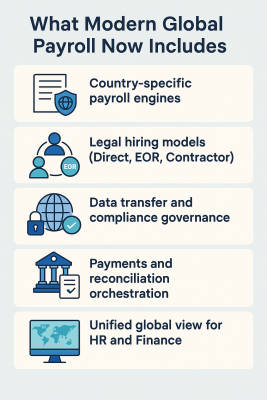
Modern global payroll is far more than just gross-to-net calculations. Key components include:
- Country-specific payroll engines. Every jurisdiction has unique rules for tax withholding, social security, holiday pay, local benefits, and filings. Leading platforms localize calculations and keep them current.
- Legal hiring models. Employers today can choose direct entity employment, EOR, or contractor workflows with unified visibility. The EOR model addresses the entity gap while assuming employer obligations in the country.
- Data transfer governance. Payroll and HR data often cross borders. Standard contractual clauses, local certifications, data minimization, and audit-ready trails are now embedded in best-in-class systems.
- Payments and reconciliation orchestration. Timely salary payouts in local currency, generating bank files, proof of payment, and full reconciliation visibility across countries are becoming table stakes.
- Unified global view for HR and Finance. Instead of fragmented local payroll systems, global payroll stacks provide one dashboard across countries with local drill-downs for compliance, filings, and reporting.
The Business Case: Faster Market Entry and Lower Risk
Here is how adopting global payroll or EOR stacks pays off:
- Speed to hire. By leveraging an EOR model or a payroll provider with local entity coverage, companies compress the time to deploy first employees in a new country from months to weeks.
- Compliance and audit readiness. Payroll becomes the single source of truth for statutory filings, benefit enrollments, and year-end reporting. Built-in controls and audit logs reduce regulatory exposure.
- Talent experience advantage. Paying accurately, locally, and on time, with clear payslips and local currency transactions, increases satisfaction and reduces attrition for remote and global teams.
- Scalability. A unified global payroll layer removes the need to reinvent local stacks each time you expand. Instead, you add countries to the existing framework.
- Risk management. Using a trusted provider reduces exposure to misclassification, permanent establishment, data transfer compliance, and local tax or social security audits.
Market Size and Momentum
Here is where things stand:
- The global payroll services market is projected to grow from roughly the low teens billion dollar zone today to around 18 billion dollars by 2030, reflecting sustained demand for multi-country compliance, payroll operations, and technology.
- The payroll outsourcing segment also shows healthy growth, indicating the movement toward specialist providers rather than building in-house for every country.
- The EOR or employer of record platform market is similarly accelerating, enabling global hiring without requiring the employer to set up entity infrastructure. These segments are adjacent and complementary to payroll services.
- Taken together, the 18 billion dollar headline captures the core payroll services market. When you include EOR and adjacent hiring technology, the total addressable market for global employment infrastructure is significantly higher.
The New Rule Book for Cross-Border Payroll Data
Today, payroll is as much a data governance problem as a payments problem. Key regulatory considerations include:
- Transfers from EU or EEA to third countries. Require either adequacy decisions or appropriate safeguards such as SCCs. The payroll system must document the legal basis for transfer and where sub-processors are used internationally.
- China’s Cross-Border Data Rules. Under the PIPL, transfers of personal information may require a security assessment, certification, or standard contracts, depending on volume and sensitivity. This affects global HR and payroll providers handling Chinese employees.
- India’s Data Protection Bill (DPDP). Establishes a framework that empowers the government to regulate data transfers via a negative list of countries. Enterprises should map payroll data and verify where it is stored and processed.
- Local wage and social contributions filings. Payroll vendors must support statutory filings, data capture for time and attendance, local benefits, amendments, and local language payslips. The data layer must support audit-ready records across jurisdictions.
- Cross-border payments transparency. Salary payments need proof of payment, local banking reconciliation, and currency exchange control, especially when paying remote employees or expatriates.
Selecting a global payroll provider is partly a data transfer decision. Where is the data stored? What legal basis is used for transfer? Which sub-processors reside in which jurisdictions? These choices carry regulatory and operational risk.
What Leading Teams Are Implementing in 2026
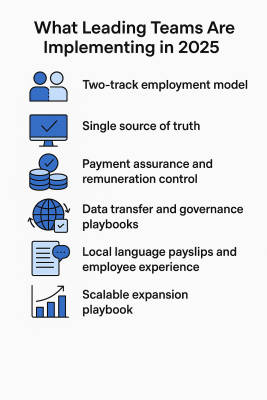
High-performing HR, finance, and global mobility teams are adopting these practices:
- Two-track employment model. Use EOR for new markets and direct entities for strategic markets, all under one unified global payroll layer.
- Single source of truth. Consolidate HRIS, time and attendance, expenses, and payroll into one ecosystem. Payroll becomes part of the global HR and finance tech stack rather than standalone.
- Payment assurance and remuneration control. Ensure country-by-country bank routing, in currency payouts, proof of payments, and full visibility into cost and obligations.
- Data transfer and governance playbooks. Document where data flows, how it is safeguarded, who the sub-processors are, and conduct annual reviews to ensure new country-specific rules are covered.
- Local language payslips and employee experience. Providing payslips in the local language and currency alongside country portals improves compliance and engagement.
- Scalable expansion playbook. Add new countries into the global payroll framework without re engineering infrastructure each time. Treat the payroll vendor as a global hiring infrastructure rather than a local service.
Also Read: A Guide to Best Global Payroll Services in 2026
Vendor Selection Checklist: Key Questions to Ask
When evaluating global payroll or EOR partners, consider this checklist:
- What countries are fully supported, including statutory filings and benefits?
- What employment models are supported, and what is the time to first hire?
- Where is data stored and processed, and what safeguards exist?
- How are payments handled, including cut-off times, currency support, and proof of payment?
- What audit and control features exist?
- How do they handle legal updates and rule changes?
- What is the employee experience, including local language and self-service access?
- What is the pricing and scalability model, and are there hidden fees?
- What is their roadmap for expansion to your upcoming markets?
- What references or performance metrics can they provide?
Risks to Manage Early
Some common pitfalls for global payroll teams include:
- Worker classification risk between contractors and employees.
- Shadow payroll obligations for short-term assignments.
- Permanent establishment risk if other activities create tax nexus in a country.
- Data transfer non-compliance if safeguards are missing.
- Local regulation blind spots due to outdated tax or labor law updates.
- Currency or payment delays that affect employee satisfaction.
- Vendors overstating global coverage without full statutory capability.
Outlook: Payroll as Global Hiring Infrastructure
Global payroll is no longer a back-office function. It is becoming the foundational layer that enables companies to operate anywhere. As cross-border data regimes mature and remote work continues, organizations that standardize payroll and EOR on a compliance-first platform will launch faster, improve employee experience, and reduce risk. With the payroll services market projected at about 18 billion dollars by 2030, cross-border hiring is an operational transformation. Companies that invest in this infrastructure today will gain a long-term advantage.
Final Impact Statement
The next wave of global hiring will be defined by how easily a company can hire in any country, pay accurately and compliantly, and integrate every worker into a single system. That is the promise of global payroll services, and that is the infrastructure companies must build today to compete globally.
FAQs
Is global payroll only for large enterprises?
No. Modern payroll and EOR platforms are accessible to mid-market companies, especially those hiring in multiple countries or avoiding entity setup costs.
Can we use one local payroll vendor per country instead of a global one?
While possible, it often creates fragmentation with different systems, disconnected payments, and inconsistent compliance. A unified global payroll layer simplifies expansion and control.
How does EOR versus direct entity employment impact payroll?
With direct entity employment you control the employment relationship and bear local obligations. With EOR you outsource employer duties to the provider. Both models still require accurate payroll and filings.
What happens if a country changes tax, social security, or data laws?
Leading vendors proactively update statutory engines and notify clients. You should include change control and update tracking in your governance process.
What is the first step for companies considering global payroll?
Map target countries for hiring, clarify hiring models, identify data and payment requirements, and issue an RFP using the vendor checklist. Build a roadmap aligned with your business expansion.
