

Many organizations still rely on disconnected and manual workflows to process documents. Think about how this typically works: Contracts are created in Word, emailed at someone’s request, printed for signatures, scanned back as PDFs, and then filed away in ambiguously named shared folders where they’re still hard to find. Each transaction in the workflow delays the process, creates inefficiencies, and adds a layer of compliance risk. For high-velocity SaaS businesses with short sales cycles and global teams, manual document workflows are simply not scalable.
These kinds of roadblocks compound over time to create an overall “drag” on operations that ultimately diminishes revenue, customer satisfaction, and team productivity. According to our platform insights, businesses that fail to automate their document workflows experience up to 40% higher administrative overhead and longer sales turnaround times compared to those using digital workflow solutions.
In this blog, we’ll explore how SignNow helps organizations streamline these processes through workflow automation and reduce document lifecycle time by up to 70%.
TL;DR
- Manual document workflows are slow, error-prone, and create operational bottlenecks.
- Workflow automation streamlines routing, approvals, and storage with minimal manual effort.
- eSignature technology removes delays from physical signing and scanning while staying legally compliant.
- SignNow combines both, acting as a full workflow engine rather than just a signing tool.
- Automations like triggers, templates, and integrations accelerate every stage of the document lifecycle.
- Organizations using SignNow achieve up to 70% faster document turnaround, improving sales velocity, compliance, and operational efficiency.
- The result: faster deal closures, reduced costs, fewer errors, and scalable processes for growing teams.
Table of Contents
Workflow Automation and eSignature
Workflow automation is the use of digital tools to simplify, improve, and perform repetitive tasks while reducing the need for manual intervention. It eliminates bottlenecks, minimizes errors, and ensures that processes move forward smoothly and efficiently. When it comes to documents, workflow automation involves automating the routing, review, approval, and storage of files through predefined rules and triggers, ensuring accuracy and consistency at every step.
The application of eSignature technology further enhances this automation by streamlining one of the most time-consuming and error-prone steps in the document lifecycle: signature collection. With eSignatures, there is no longer a need for paper, printing, scanning, or emailing files back and forth. Signers can conveniently review and approve documents from any device, at any time, and from anywhere in the world.
Importantly, eSignatures hold the same legal validity as traditional handwritten (wet) signatures in most jurisdictions, including ESIGN in the US, eIDAS in the EU, and UETA, ensuring that digital signing is not only efficient but also secure and compliant.
Together, workflow automation and eSignature technology enable a seamless, end-to-end document process that keeps human involvement focused only on critical decision points rather than repetitive administrative tasks. This synergy not only accelerates document turnaround times but also improves productivity, compliance, and overall operational efficiency.
What is SignNow?
SignNow has emerged as a leading choice for businesses looking to modernize the way they manage documents. It is a top workflow automation and eSignature platform that helps teams streamline their document processes from start to finish. With SignNow, users can create automated signing workflows, integrate them seamlessly into existing SaaS tools such as CRMs and cloud storage, and monitor every step of the signing process in real time.
Thanks to its robust automation capabilities, SignNow goes beyond basic eSignature tools by enabling a fully automated document lifecycle, reducing manual effort and ensuring greater speed, accuracy, and compliance.
SaaSworthy Insights: SignNow is consistently rated as one of the top workflow automation platforms for SMBs and mid-market enterprises, recognized for its balance between usability, scalability, and integration depth. According to SaaSworthy’s analysis, it ranks highly for customer satisfaction and product adaptability, outperforming several competitors in automation features and cross-platform integrations.
Achieving a 70 % Reduction in Document Lifecycle Time
The organizations that use SignNow have seen a reduction of time in document lifecycle of nearly 70%. Tasks that would take days, if not weeks, now only take hours. The ramifications for sales speed, compliance, efficiency and client experience are substantial.
Understanding the Core Technology
What is Workflow Automation
Automated workflows implement rule-based logic across business processes. Rather than advancing documents manually at each process step, automated workflows move documents among stakeholders, updating content and archiving the documents when appropriate triggers indicated ingest and execution.
For example:
- When a sales rep marks a deal as “Closed Won” in the CRM, a contract is automatically generated and routed to legal for approval.
- Once legal signs off, it is automatically sent to the customer for signature.
- Upon completion, the signed contract is stored in a secure cloud repository and metadata is pushed back into the CRM.
No emails. No PDFs shuttling around. No bottlenecks.
The Role of eSignature in Automation
eSignatures serve as the foundation for this process. Signing the traditional way requires a person to be there, or a pdf to be scanned, which lengthens the entire process. eSignatures enable stakeholders to sign, their convenience, directly from wherever they are, on whatever device they are using, instantly.
Modern eSignature solutions also include:
- Signer authentication through email, SMS, or ID verification
- Multi-signer support, enabling sequential or parallel signing
- Automatic time stamps and audit trails for legal defensibility
- Expiration dates and reminders, ensuring documents do not stall
This combination eliminates one of the biggest bottlenecks in traditional workflows: waiting on signatures.
SaaSworthy Insights: According to SaaSworthy data, businesses that integrate eSignature solutions into their workflows experience up to 3x faster approval cycles and a 25–30% reduction in document-related errors.
SignNow Features Enabling Efficiency
SignNow is more than an eSignature app. It is a comprehensive workflow engine. Key capabilities include:
- Drag-and-drop workflow builders to design signing sequences
- Pre-filled templates that pull data from CRMs or HR systems, eliminating manual entry
- Conditional routing based on contract value, department, or region
- Integrations with Salesforce, HubSpot, Google Drive, OneDrive, Box, and other SaaS tools
- Real-time tracking dashboards for visibility across departments
This positions SignNow as a strategic infrastructure layer rather than a single-purpose signing tool.
How SignNow Reduces Document Lifecycle Time
Defining the Document Lifecycle
The document lifecycle typically includes four key phases:
- Preparation – Drafting, editing, and formatting the document
- Routing and Review – Sharing with internal stakeholders for approval
- Signature Collection – Getting the document signed by all parties
- Archiving and Retrieval – Storing, indexing, and retrieving documents when needed
In manual workflows, each phase can take hours or days. Bottlenecks often occur during routing, signature collection, and filing.
SignNow Features Enabling Efficiency
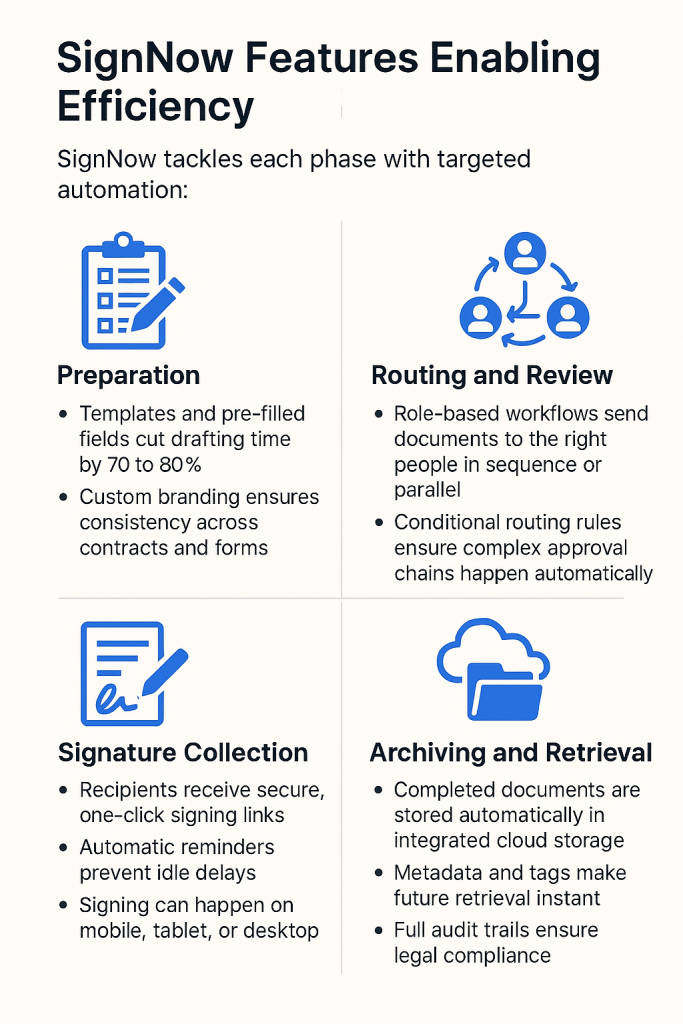
Specific Automation Techniques
SignNow uses a combination of triggers, templates, and integrations to achieve these results:
- Trigger-based routing, for example: “If amount > $50,000, route to legal before CEO.”
- CRM integration to automatically insert customer names, deal values, and addresses
- Parallel workflows that allow multiple departments to approve simultaneously
- Expiration and escalation, where reminders are sent automatically and overdue signers can be escalated
- Secure archival with encryption and audit trails
Quantifying the Impact: The 70% Reduction
Measuring Document Lifecycle Time
Organizations measure lifecycle time by tracking:
- Average document preparation time
- Average approval and routing time
- Average signature turnaround time
- Average time to archival
By automating these steps, SignNow drastically reduces the cumulative lifecycle.
Case Studies and Metrics
| Stage | Traditional Workflow | With SignNow |
| Document Preparation | 2–3 hours | 20–30 minutes using templates |
| Routing for Approvals | 1–2 days via email | Instant automated routing |
| Signature Collection | 3–5 days (scanning, chasing) | 1 day or less via digital signing |
| Filing and Archiving | Manual foldering | Automated cloud storage with indexing |
Actual deployments provide turnaround speed improvements that range from 60 to 70 %, notably for organizations in the SaaS, legal, construction, and HR tech industries. If a business handles 500 or more documents each month, this means hundreds of hours saved, faster revenue cycles, and an improve compliance posture.
Benefits Beyond Time Savings
- Cost Reduction through lower printing, paper, and courier costs
- Error Minimization with pre-filled data ensuring accuracy
- Stronger Compliance with centralized audit trails supporting legal defensibility
- Scalability to handle growth in document volume without hiring more administrative staff
- Improved Customer Experience through a frictionless signing process
Conclusion
The combination of eSignature and workflow automation functionality allows SignNow to optimize every phase of the document lifecycle. By minimizing manual work, implementing intelligent routing, and connecting seamlessly with the SaaS tools you’re already using, it turns a back-office function often overlooked by executive teams into a strategic efficiency accelerator.
Final Impact Statement
The result is up to 70 % reduction in document lifecycle time. Businesses can close deals faster, onboard employees more efficiently, stay compliant with less effort, and scale without friction.
Future Outlook
As AI and machine learning advance, the future of workflow automation will include predictive routing, smart contract validation, automated clause suggestions, and intelligent dashboards that flag delays proactively. SignNow’s infrastructure-first approach positions it strongly to integrate these innovations, aligning with SaaSworthy’s forecast that AI-driven workflow automation will become the next major differentiator in the eSignature market by 2026.
Frequently Asked Questions (FAQs)
1. What is document lifecycle time and why does it matter?
Document lifecycle time refers to the total duration a document takes to move from creation to final storage, including preparation, routing, signing, and archiving. Longer lifecycle times can delay sales cycles, onboarding, and compliance processes. Reducing this time directly impacts revenue recognition, operational agility, and customer experience.
2. How does workflow automation differ from basic eSignature tools?
Basic eSignature tools focus only on collecting signatures electronically. Workflow automation platforms like SignNow go further by automating routing, notifications, conditional approvals, data pre-filling, and secure archival, which streamlines the entire lifecycle rather than just the signing step.
3. Is SignNow legally compliant for business contracts?
Yes. SignNow complies with ESIGN, UETA, and eIDAS regulations, making its signatures legally binding in the U.S., EU, and many other jurisdictions. It also supports SOC 2 Type II and GDPR compliance, and offers audit trails, encryption, and access controls to meet enterprise-grade security standards.
4. How does SignNow integrate with existing SaaS tools?
SignNow integrates seamlessly with CRMs like Salesforce and HubSpot, cloud storage platforms like Google Drive and OneDrive, and productivity suites. This allows organizations to automatically populate data, trigger workflows from other apps, and store signed documents securely without manual uploads.
5. Can small teams benefit from workflow automation or is it only for large enterprises?
Small teams benefit significantly. By automating document workflows, small businesses can operate at enterprise-level efficiency without adding administrative overhead. Automated templates, reminders, and signing flows free up time for core business activities while ensuring professionalism and compliance.
6. What kind of ROI can businesses expect after implementing SignNow?
Businesses typically see:
- 70 % faster document turnaround times
- Reduced printing and courier costs
- Fewer manual errors and delays
- Faster revenue cycles through accelerated contract closures
- Lower administrative overhead as document volumes scale
The ROI compounds over time, especially for organizations processing hundreds or thousands of documents monthly.
Key Takeaway
Using eSignature to automate workflows is no longer a luxury. It is now an operational imperative. Organizations using SignNow are replacing slow and error-prone workflows with fast, secure, and scalable workflows that create real business impact.
