

Walmart dropshipping is often presented as a low-inventory business model, but the operational risk sits with the seller.
A supplier can hold the inventory and ship the order, yet Walmart still evaluates the seller’s marketplace performance. That makes a dropshipping platform’s automation capabilities more important than its product count alone.
Inventory accuracy, supplier processing times, order routing, tracking, returns, and Walmart integration can directly affect how much manual control a seller retains.
This guide compares five platforms through that lens, rather than treating every supplier directory or automation tool as interchangeable.
Quick Summary:
- Best for AI-Assisted Walmart Workflows: Doba (AI-assisted research, product sourcing, Walmart listing, syncing, and fulfillment-related workflows)
- Best for U.S. Wholesale: TopDawg (Access to 500k+ U.S. wholesale SKUs)
- Best for Feed Automation: Inventory Source (Direct supplier feed sync for real-time stock and pricing updates)
- Best for Enterprise Scaling: Flxpoint (Advanced supplier mapping and multi-warehouse routing rules)
- Best for Global Catalog: AppScenic (1M+ items with 24/7 inventory monitoring)
What Is Walmart Dropshipping?
Walmart dropshipping is a fulfillment model in which a seller lists products on Walmart Marketplace without holding the inventory directly. When a customer places an order, the supplier or fulfillment partner ships the product to the customer on the seller’s behalf.
Walmart Dropshipping Policy in 2026: Rules and Requirements
Before choosing a dropshipping platform for Walmart, understand the marketplace requirements that affect your fulfillment model.
Walmart currently requires sellers to meet the following key requirements:
- Fulfillment: For Marketplace qualification, sellers must have fulfillment through WFS or another B2C U.S. warehouse with returns capability.
- Product compliance: Ensure your catalog follows Walmart’s Prohibited Products Policy and applicable marketplace requirements.
- Returns: Set up a returns process that meets Walmart’s requirements and supports the applicable fulfillment model.
- Seller performance: Meet Walmart’s applicable performance standards for areas such as order response, tracking, cancellations, refunds, and delivery.
- Catalog and business verification: Provide the required business information, product identifiers, and supporting documentation during Marketplace onboarding.
Does Walmart Allow Dropshipping?
Yes. Walmart allows dropshipping, provided sellers meet its Marketplace, fulfillment, returns, and seller-performance requirements.
For Marketplace qualification, Walmart currently requires sellers to fulfill orders through Walmart Fulfillment Services (WFS) or another B2C U.S. warehouse with returns capability.
However, Walmart distinguishes supplier-based fulfillment from retail arbitrage. Sellers should not purchase products from another online retailer and have that retailer ship the order directly to the Walmart customer.
This means you can use a third-party dropshipping supplier to source and fulfill products, but the Walmart seller remains responsible for meeting applicable requirements for product listings, inventory accuracy, shipping, returns, and customer service.
Key Features of the Best Dropshipping Platforms for Walmart
A Walmart dropshipping platform should handle inventory, orders, pricing, and tracking efficiently. Here are the key features to compare before making a choice:
- Walmart Marketplace Integration: Connects directly with Walmart Seller Center to manage product listings, inventory, pricing, orders, and shipment updates.
- U.S.-Based Inventory & Suppliers: Offers domestic suppliers and warehouse stock to support faster delivery, easier returns, and fewer cross-border fulfillment issues.
- Real-Time Inventory & Price Sync: Automatically updates stock levels and supplier prices to prevent overselling, outdated listings, and margin loss.
- Automated Order & Tracking Workflows: Routes Walmart orders to suppliers and syncs shipment status and tracking details to reduce manual processing.
- Walmart-Compatible Workflows: Supports listing, inventory, pricing, order, tracking, and fulfillment workflows that can help sellers manage Walmart requirements.
- Supplier Quality & Product Selection: Evaluates supplier reliability, processing times, product data, return policies, packaging, and product restrictions beyond catalog size.
- Pricing, Fees & Scalability: Compare subscription costs, order fees, supplier prices, shipping charges, Walmart referral fees, product limits, and integration capacity as sales grow.
How Much Does Walmart Dropshipping Cost?
The cost of Walmart dropshipping depends on your supplier, product category, fulfillment model, and sales volume. While Walmart Marketplace currently has no setup or monthly subscription fees, sellers pay category-based referral fees on completed sales.
Here are the typical Walmart dropshipping cost factors:
- Dropshipping platform subscription: Free plans are available, while paid plans can range from monthly subscriptions to higher enterprise tiers.
- Supplier and product costs: You pay the supplier for each product ordered.
- Shipping and fulfillment: Costs depend on the supplier, destination, package size, and delivery method.
- Referral fees: Walmart charges a percentage of each sale based on the product category.
- Returns and refunds: These can reduce margins when customers return products.
- Advertising: Sponsored listings and other Walmart advertising add optional costs.
- Payment processing: Payment-related charges may apply depending on your payment setup.
- Automation and integrations: Advanced tools may require additional fees.
Therefore, calculate total Walmart dropshipping costs, rather than evaluating platforms based only on their subscription price.
How We Evaluated the Best Dropshipping Platforms for Walmart
We evaluated each platform based on how well it supports the complete Walmart dropshipping workflow, from sourcing and listing products to fulfilling orders.
The table below highlights the key factors used in our comparison.
| Evaluation Factor | What we considered |
| Walmart integration | Product listing, catalog, inventory, pricing, orders, and shipment functions. |
| Supplier network | Supplier availability, product selection, sourcing model, and supplier access. |
| U.S. inventory | Domestic suppliers, warehouses, and fulfillment options. |
| Inventory sync | Frequency and scope of stock-level updates. |
| Price sync | Automated supplier-price and selling-price updates. |
| Product management | Product data, listing tools, attributes, and catalog controls. |
| Order automation | Order import, supplier routing, processing, and status updates. |
| Tracking | Shipment and tracking-number synchronization with Walmart. |
| Fulfillment | Processing, shipping, returns, and fulfillment workflows. |
| Pricing | Subscription costs, order charges, integrations, and plan limits. |
| Seller fit | Suitability for new, growing, multi-supplier, and high-volume sellers. |
Moreover, we assessed each platform’s automation, supplier model, fulfillment workflow, catalog, costs, and manual effort to determine how well it fits different Walmart selling setups.
5 Best Dropshipping Platforms for Walmart Sellers in 2026
We compared five dropshipping platforms using current product information and Walmart-specific evaluation criteria.
Here’s what we found about their features, pricing, automation, and integrations.
| Platform | Best For | Walmart Integration | U.S. Supplier Access | Inventory Sync | Order Automation | Starting Price and Billing Basis |
| Doba | AI-assisted Walmart workflows | Yes | Yes | Yes | Yes | $28.66/month, billed quarterly. |
| TopDawg | U.S. sourcing | Yes | Yes | Yes | Yes | $34.99/month per integration, billed annually. |
| Inventory Source | Feed and order automation | Yes | Depends on supplier | Yes | Full Automation plan required | Inventory Automation: $199/month; Full Automation: $299/month. |
| Flxpoint | Multi-supplier operations | Yes | Depends on suppliers | Yes | Yes | $799/month with monthly billing; $699/month equivalent with annual billing. |
| AppScenic | Global sourcing | Yes | Yes | Yes | Yes | $39/month for the Standard plan. |
Note: Walmart integration, U.S. supplier access, and automation features may vary by plan and supplier. Verify current pricing and feature availability before subscribing.
1. Doba: Best for AI-Assisted Walmart Workflows
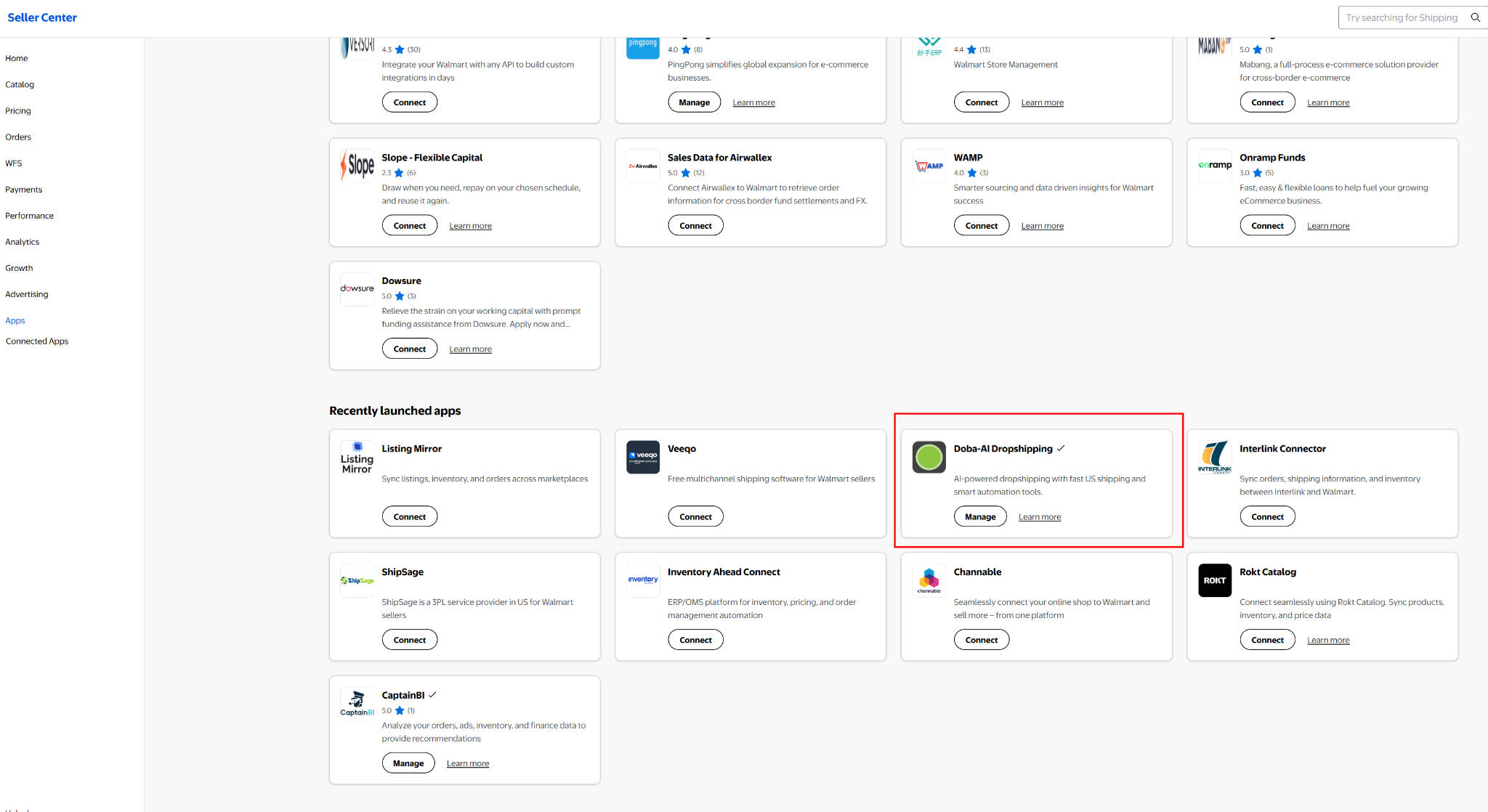
Doba is an AI-powered dropshipping operations platform with an official Walmart integration. It supports product sourcing, one-click listing, inventory and price synchronization, order workflows, and tracking. Furthermore, Doba Pilot adds AI-assisted product research, listing creation, and direct Walmart publishing, making Doba an all-in-one dropshipping platform.
Doba Key Features for Walmart Sellers
- Walmart integration: Connects Doba directly with Walmart for listing, inventory, pricing, orders, and fulfillment workflows.
- One-click listing: Lets sellers source products and publish them to Walmart with fewer manual steps.
- Inventory synchronization: Keeps Walmart listings aligned with supplier stock levels to reduce overselling.
- Price synchronization: Updates product prices when supplier costs change.
- Doba Pilot: Uses AI for product research, sourcing, listing creation, optimization, and supported fulfillment tasks.
- U.S.-stocked products: Provides access to 1M+ products, with approximately 90% stocked in U.S. warehouses.
Doba Pros
- Official Walmart integration supports marketplace-specific workflows.
- Combines product sourcing with listing and fulfillment automation.
- A large U.S.-stocked catalog supports domestic sourcing strategies.
Doba Cons
- Advanced tools and higher usage limits require paid tiers.
- Product, shipping, handling, and other transaction costs are separate.
Doba Pricing
Doba offers four paid plans: Limited ($29.99/month), Basic ($59.99/month), Standard ($149.99/month), and Enterprise ($299.99/month) on monthly billing. It offers 5% off on quarterly plans and 15% off on yearly plans. Doba also offers a $0.99 Basic Trial for up to 7 days and a $0.99 Standard Trial for up to 5 days.
2. TopDawg: Best for U.S. Wholesale Suppliers
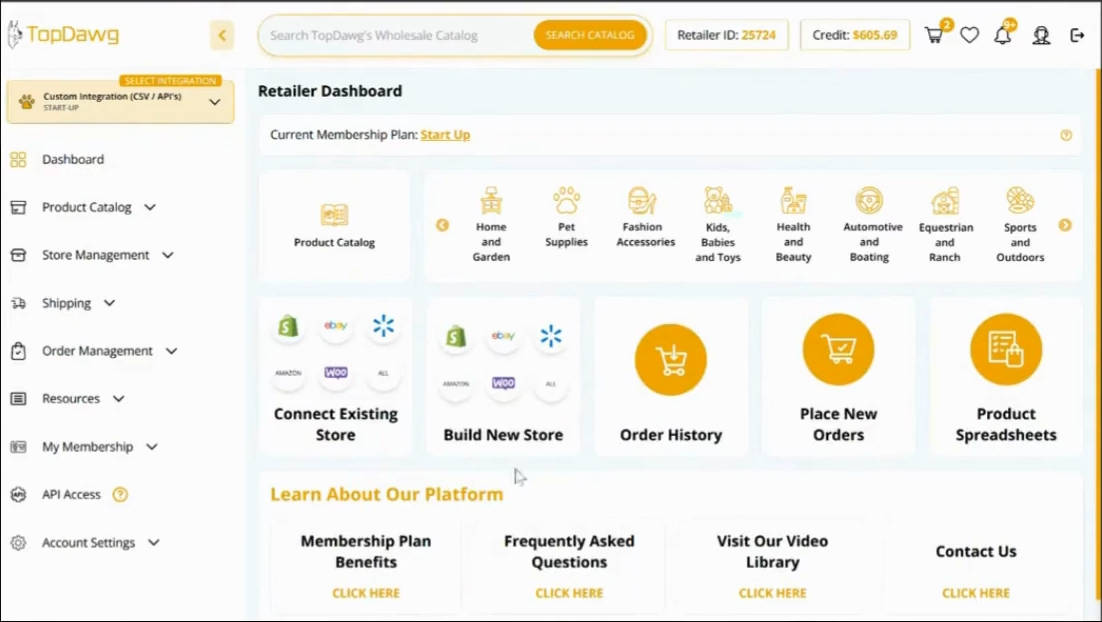
TopDawg combines access to U.S. wholesale suppliers with marketplace integrations, product synchronization, order automation, and tracking. Its domestic supplier focus makes it relevant for Walmart sellers who prioritize U.S.-based fulfillment, faster domestic shipping, and simpler supplier sourcing.
TopDawg Key Features for Walmart Sellers
- Walmart integration: Connects Walmart Seller Center with TopDawg’s supplier network.
- U.S. suppliers: Provides access to domestic wholesale products for Walmart sellers.
- Real-time syncing: Updates product information, inventory, and pricing across connected channels.
- Order automation: Routes Walmart orders through the supplier fulfillment workflow.
- Tracking updates: Sends shipment information back to the connected sales channel.
- Branded packing slips: Available on eligible higher-tier plans for qualifying orders.
TopDawg Pros
- Strong focus on U.S.-based wholesale suppliers.
- Entry-level plan lets sellers explore the platform before upgrading.
- Supports product, order, inventory, and tracking workflows for Walmart.
TopDawg Cons
- Separate subscriptions may apply to different connected channels.
- Paid plans can include order-processing costs beyond the subscription.
TopDawg Pricing
TopDawg offers a free Start Up plan, while paid plans start at $34.99/month for Business, followed by Scale at $69.99/month and Premier at $139.99/month. Paid plans are priced per integration and billed annually. The Business plan includes a free trial.
3. Inventory Source: Best for Supplier-Feed Automation
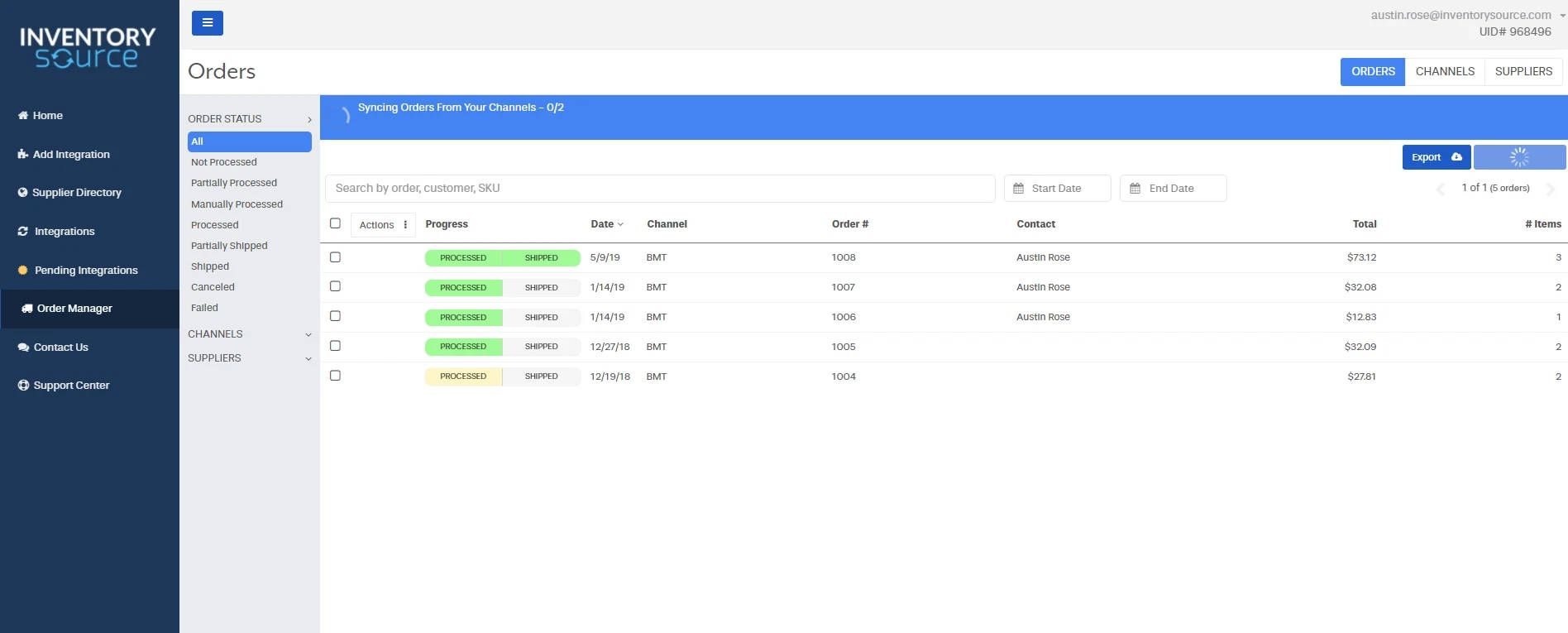
Inventory Source focuses on supplier-feed and inventory automation for sellers that already work with external suppliers. Its tools can synchronize product data, inventory, pricing, orders, and shipment tracking across supported marketplaces and sales channels.
Inventory Source Key Features for Walmart Sellers
- Walmart integration: Connects supplier feeds and automation workflows with Walmart.
- Inventory automation: Synchronizes supplier stock, product data, and availability.
- Product-data sync: Transfers titles, descriptions, images, categories, and other supplier data.
- Price synchronization: Applies pricing rules and updates marketplace prices from supplier data.
- Order routing: Full Automation routes orders to connected suppliers.
- Tracking synchronization: Sends supplier shipment tracking back to the sales channel.
Inventory Source Pros
- Designed for sellers managing external supplier feeds.
- Full Automation combines inventory, order, and tracking workflows.
- Supports large catalogs and multiple supplier integrations.
Inventory Source Cons
- Higher plans can cost more than basic dropshipping platforms.
- Supplier quality and fulfillment performance still require seller oversight.
Inventory Source Pricing
Inventory Source offers a Free Supplier Directory ($0/month), Inventory Automation Starter ($199/month), Inventory Automation Power Seller ($499/month), Full Automation Starter ($299/month), and Full Automation Power Seller ($599/month).
4. Flxpoint: Best for Multi-Supplier Operations
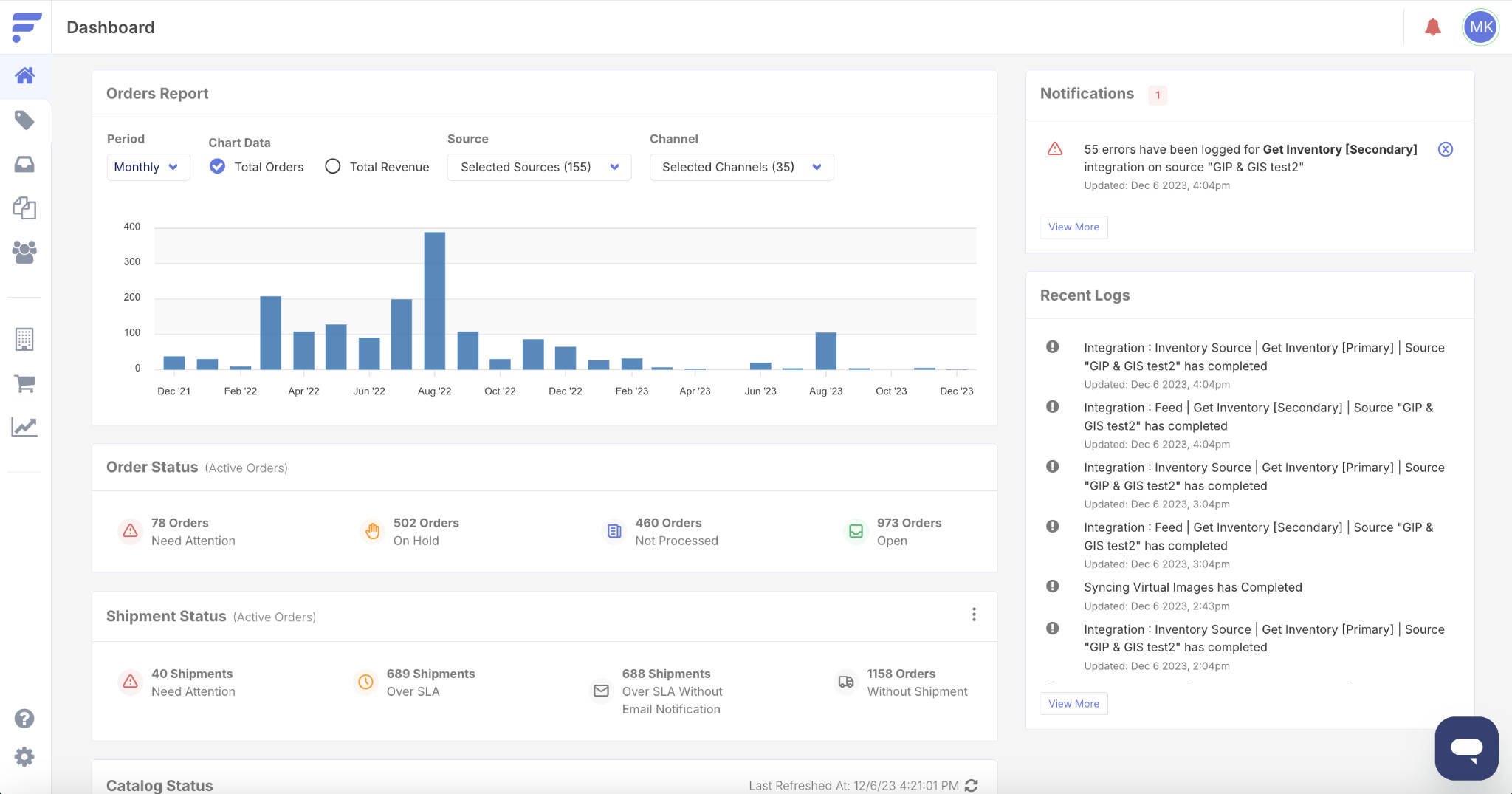
Flxpoint is designed for retailers managing multiple suppliers, large product catalogs, warehouses, and sales channels. Its Walmart integration supports listing publication, category mapping, inventory and price synchronization, order management, fulfillment workflows, and shipment updates.
Flxpoint Key Features for Walmart Sellers
- Walmart channel integration: Connects Walmart with Flxpoint’s multichannel operations platform.
- Inventory synchronization: Updates Walmart inventory from connected suppliers and warehouses.
- Price synchronization: Applies configured pricing rules to Walmart listings.
- Order routing: Routes orders based on supplier, warehouse, inventory, and workflow rules.
- Product mapping: Maps supplier data and categories to Walmart’s marketplace requirements.
- Shipment synchronization: Sends fulfillment and tracking information back to Walmart.
Flxpoint Pros
- Built for complex multi-supplier ecommerce operations.
- Supports large SKU and order volumes on the Business plan.
- Advanced routing helps manage suppliers and fulfillment sources.
Flxpoint Cons
- Pricing is considerably higher than entry-level dropshipping tools.
- Complex setups can require more configuration and onboarding.
Flxpoint Pricing
Flxpoint offers Business ($799/month or $699/month billed annually), Pro (custom pricing), and Enterprise (custom pricing). Business includes 8 source and 2 channel connectors, while Pro and Enterprise are designed for larger multi-supplier operations.
5. AppScenic: Best for Global Product Sourcing
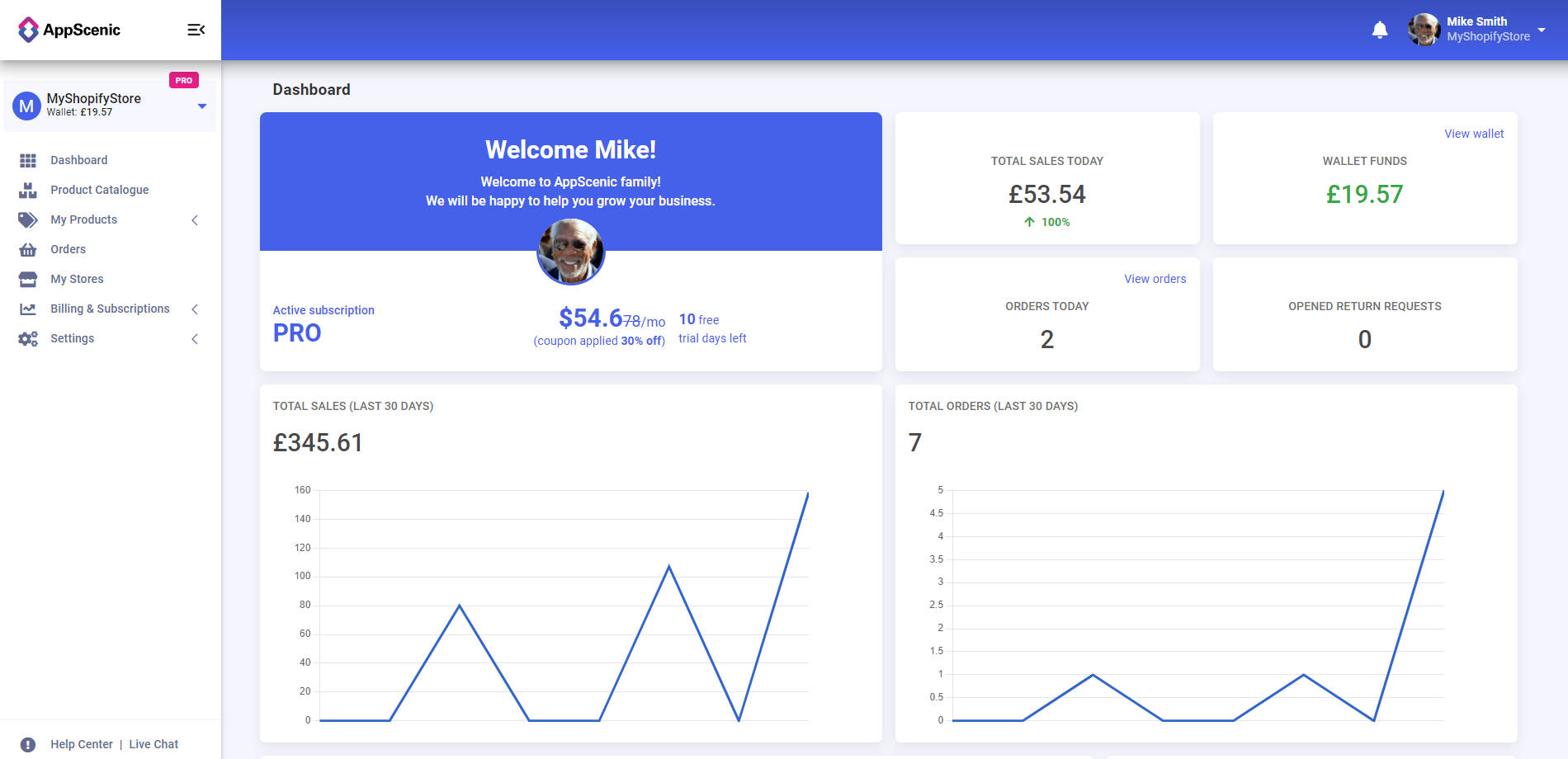
AppScenic combines product sourcing with automated marketplace operations. It offers more than 1 million products from suppliers across the U.S., UK, EU, Canada, and other markets, along with 24/7 inventory and price synchronization, automated ordering, tracking imports, and AI product tools.
AppScenic Key Features for Walmart Sellers
- Walmart integration: Connects Walmart with AppScenic for product and order automation.
- 1M+ products: Provides a large catalog across more than 100 product categories.
- 24/7 synchronization: Continuously updates supplier prices and inventory.
- Automatic ordering: Routes Walmart orders to suppliers without manual processing.
- Tracking imports: Automatically sends shipment tracking to the connected store.
- AI product tools: Supports product titles, descriptions, translations, images, and SEO optimization.
AppScenic Pros
- Large catalog with suppliers across major markets.
- Continuous price and stock synchronization reduces manual checks.
- AI tools cover product optimization alongside fulfillment automation.
AppScenic Cons
- Premium products are restricted to higher-tier plans.
- Delivery speed depends on the selected supplier and fulfillment location.
AppScenic Pricing
AppScenic offers Free ($0/month), Standard ($39/month), Pro ($79/month), and Elite ($99/month). Paid plans include a 14-day free trial, and the Free plan does not expire.
How to Choose the Best Dropshipping Platform for Walmart?
The best platform for dropshipping depends on your suppliers, fulfillment model, sales volume, and catalog size. Here are the key steps to compare your options:
Step 1: Define your fulfillment model: Check U.S. inventory, supplier processing times, shipping locations, return handling, and whether the setup meets Walmart or WFS requirements.
Step 2: Test the Walmart integration: Before importing your catalog, test product listings, category mapping, SKUs, inventory updates, pricing, order imports, and tracking synchronization.
Step 3: Verify suppliers: Review supplier locations, processing times, packaging, shipping methods, return policies, product data, and inventory accuracy. Order samples when possible.
Step 4: Calculate total costs: Include supplier prices, shipping, Walmart referral fees, platform subscriptions, order fees, returns, advertising, and other operating expenses when calculating margins.
Step 5: Match automation to volume: Choose automation based on your SKU count, order volume, suppliers, and sales channels. Avoid paying for enterprise features before they solve a real operational need.
Which Walmart Dropshipping Platform Is Right for You?
Each platform fits a different Walmart selling model, from U.S. sourcing to multi-supplier automation. The table below outlines the main use cases for each option.
| If you need… | Choose… |
| AI-assisted product research and Walmart listing workflows | Doba |
| Supplier-feed and inventory automation | Inventory Source |
| Multi-supplier operations and marketplace integrations | Flxpoint |
| U.S.-based supplier sourcing and fulfillment | TopDawg |
| Wholesale product sourcing and supplier discovery | Doba |
| Walmart listing and multi-channel product synchronization | Doba or Flxpoint |
| Automated ordering and access to premium products | AppScenic |
| Free catalog exploration before subscribing | AppScenic |
Note: AppScenic’s free plan supports catalog browsing and product imports. Selling, inventory sync, and order automation require a paid plan. Features and limits vary by subscription, supplier, and marketplace.
Which Dropshipping Platform Fits Your Walmart Business?
Based on this evaluation, Doba emerges as the most broadly aligned platform for Walmart sellers, particularly for those who want sourcing, Walmart integration, listing automation, and AI-assisted workflows in one platform.
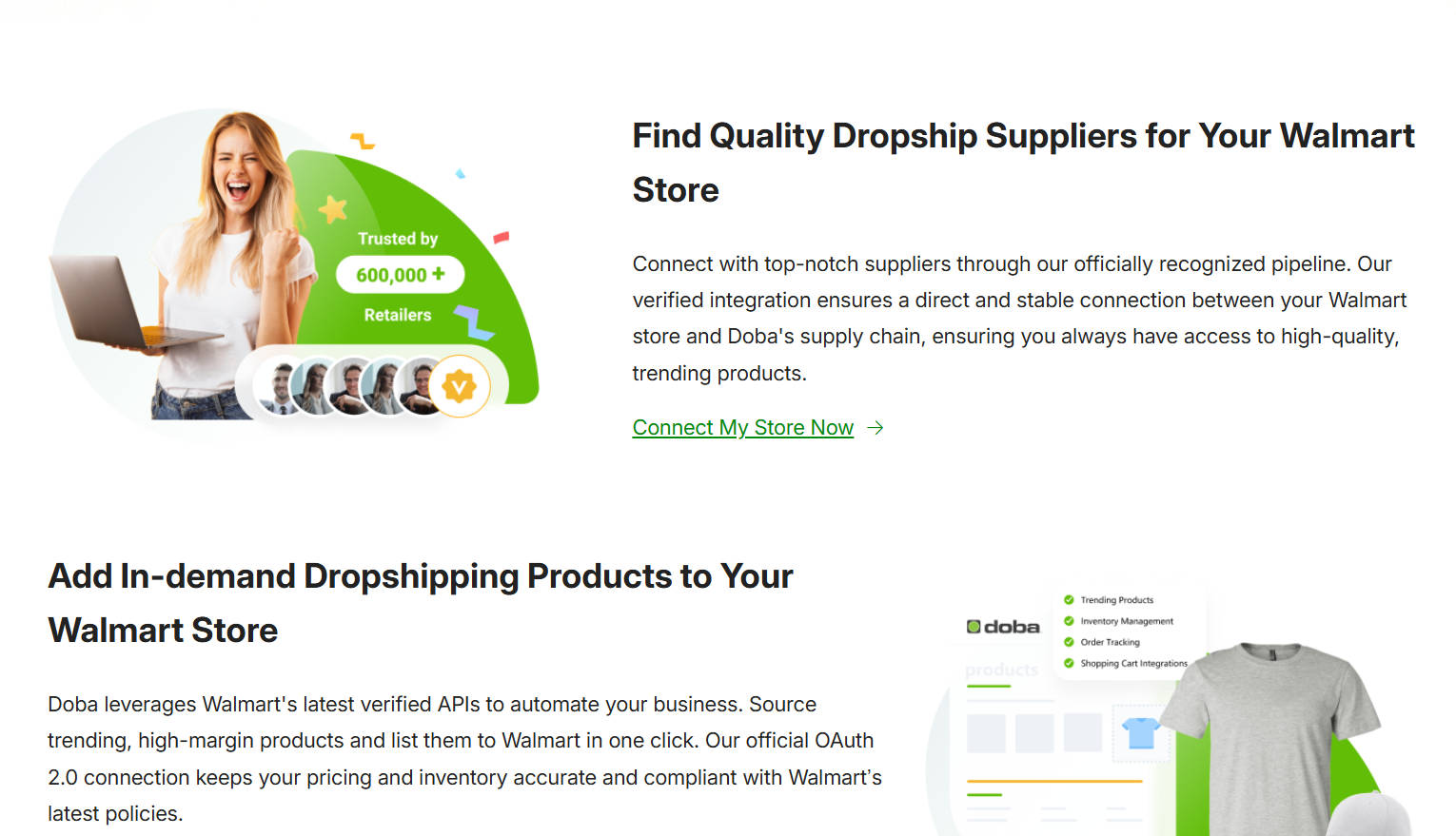
However, sellers with supplier feeds, multi-supplier workflows, or broader catalogs can also consider TopDawg, Inventory Source, Flxpoint, and AppScenic.
The right choice ultimately depends on your supplier model, fulfillment requirements, sales volume, catalog size, and operating budget. Evaluate these factors before committing to a platform.
FAQs
1. Is Walmart dropshipping legal?
Yes. Walmart dropshipping is legal when sellers comply with applicable laws and Walmart Marketplace policies.
2. Can you dropship on Walmart without holding inventory?
Yes. You can use a dropshipping supplier that stores and fulfills products for you. However, you remain responsible for Walmart’s seller, fulfillment, returns, and performance requirements.
3. What is the best dropshipping platform for Walmart?
Doba is one of the best dropshipping platforms in 2026, especially for sellers who want AI-assisted product sourcing, Walmart integration, inventory syncing, and order automation in one platform.
4. What should I look for in a Walmart dropshipping supplier?
Look for U.S. inventory, accurate stock data, fast processing, reliable tracking, clear returns, compliant products, and Walmart-compatible fulfillment.
5. How much does Walmart charge dropshippers?
Walmart does not charge setup or monthly Marketplace fees. Sellers pay category-based referral fees, while WFS adds applicable fulfillment and storage fees.
6. Do Walmart dropshipping platforms automate orders?
Yes. Many platforms can import Walmart orders, route them to suppliers, and sync shipment and tracking information back to Walmart.
7. How do I find the best dropshipping suppliers for Walmart?
To find the best dropshipping suppliers for Walmart, compare their U.S. inventory, product selection, fulfillment speed, Walmart integration, inventory accuracy, pricing, and return policies.
8. Can international sellers dropship on Walmart?
Yes. Eligible international sellers can sell on Walmart Marketplace, subject to country eligibility, verification, fulfillment, returns, and other marketplace requirements.
