

Website traffic can drop despite good SEO rankings when organic click-through rates decline, search demand falls, search intent changes, competitors gain more SERP visibility, or AI Overviews and other zero-click features answer queries before users visit a website. Technical or tracking issues can also make an apparent traffic decline look worse than it is.
A higher ranking no longer guarantees the same number of clicks. Google AI Overviews, featured snippets, videos, People Also Ask, and other SERP features can take attention away from traditional organic listings.
So, why is website traffic dropping despite good SEO rankings? This guide explains the key causes, shows how to diagnose the real source of traffic loss, and outlines practical ways to recover organic search traffic.
KEY TAKEAWAYS:
- Stable rankings no longer guarantee steady traffic. CTR, search demand, SERP features, and changing search intent can reduce clicks.
- Use Google Search Console to compare clicks, impressions, CTR, and rankings to identify why website traffic is dropping despite good SEO rankings.
- Combine SEO with AI SEO and AEO to track broader search visibility, including AI mentions, citations, referrals, and SERP features.
Why Is Your Website Losing Traffic Despite Good SEO Rankings?
Understanding why website traffic is dropping despite good SEO rankings starts with looking beyond rankings at clicks, search demand, and SERP visibility. Here are the key factors behind traffic loss:
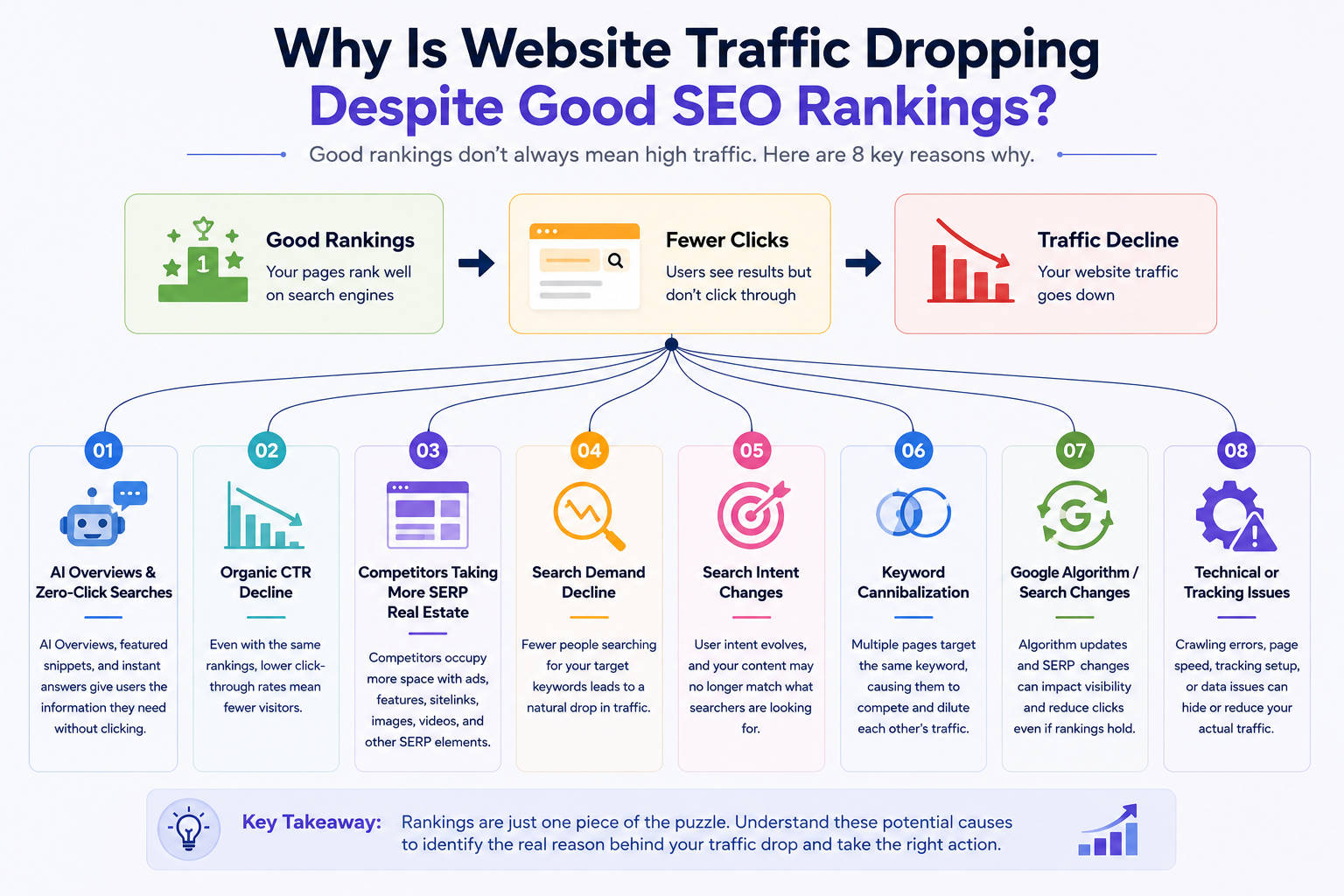
A. AI Overviews and Zero-Click Searches Are Reducing Clicks
One of the biggest changes in modern search is the rise of answer-first experiences.
Google AI Overviews can provide a synthesized answer at the top of the results page, with links to supporting websites. Featured snippets can also answer a query without requiring users to open the source page.
This can contribute to a zero-click search. The user finds enough information on the SERP and leaves without clicking an organic listing.
The impact is measurable– a 2025 Pew study of 68,879 Google searches found traditional result clicks fell to 8% when an AI summary appeared, versus 15% without one. Only 1% clicked a link within the AI summary.
This matters most for informational queries such as:
- What is accounts payable?
- How does cloud computing work?
- What is a CRM?
- How much does a website cost?
However, do not assume every AI Overview causes traffic loss.
The real question is whether your high-traffic queries now show more AI Overviews or zero-click features. If impressions stay stable while CTR falls, the SERP itself may be part of the problem.
B. Your Organic CTR Has Fallen
CTR becomes especially important when rankings are good, but traffic is down.
For example, a page with 10,000 impressions and an 8% CTR receives 800 clicks. If CTR falls to 4%, the same page receives only 400 clicks. The ranking can remain unchanged while traffic is cut in half.
There are multiple factors that can reduce CTR, such as:
- AI Overviews
- Featured snippets
- Stronger competitor titles
- Additional SERP features
- Changes in search intent
- Less compelling title tags
- Greater brand preference
Start with pages and queries that have high impressions but declining CTR. Then inspect the current SERP to understand what changed.
If competitors or SERP features now attract more attention, the issue may be click-through performance rather than ranking visibility.
C. Competitors Are Taking More SERP Real Estate
Your ranking position shows where your traditional result appears, but it does not show how much attention your listing receives. Competitors can take more SERP real estate through:
- AI Overviews
- Featured snippets
- People Also Ask
- Video results
- Shopping results
- Image results
For example, your page may still rank #2 for a commercial query, while a competitor appears in the featured snippet, video carousel, and AI Overview. Your position has not changed, but the competitor now has more opportunities to attract the same searcher.
This is one reason rankings are good, but traffic is down even when your position has not changed.
When investigating a traffic decline, inspect the actual SERP for your most important queries. Check:
- Where competitors appear.
- How much SERP space they occupy.
- Whether they appear in multiple features.
- Whether your listing still stands out.
If competitors have gained more SERP visibility while your rankings remain stable, the shift in search real estate may be reducing your clicks.
D. Search Demand Has Declined
Sometimes your SEO is fine. There are simply fewer people searching for the topic.
Search demand can fall because of seasonality, changes in consumer behavior, new products or technologies, industry shifts, economic conditions, declining interest, or changes in how people phrase queries.
Google Trends can help you compare search interest across different periods and identify whether a topic has lost demand.
Google Search Console provides another useful signal. Suppose your page had:
- 100,000 impressions
- 5,000 clicks
- Position 3
Later, it has:
- 70,000 impressions
- 3,500 clicks
- Position 3
The ranking has not changed, and the CTR remains similar. The traffic decline is therefore more likely linked to lower search demand or fewer eligible searches.
In this case, changing the page may not solve the problem. First, confirm whether people are still searching for the topic.
E. Search Intent Has Changed
Search intent can change over time. A query that once produced detailed articles may now favor videos, comparison pages, product listings, or AI-generated answers.
For example, someone searching for “best project management software” may now expect:
- A product comparison.
- Pricing details.
- User reviews.
- Recommendations
- A quick AI-generated summary.
Likewise, someone searching “how to fix a leaking tap” may prefer a short video over a 2,000-word guide.
This can explain why rankings are good, but traffic is down. Your page may still rank well, but it may no longer match the format or depth users expect.
To diagnose this, compare today’s SERP with the results from when traffic was stronger. Check whether the dominant content format, SERP features, or questions have changed.
F. Your Pages May Be Competing With Each Other
Keyword cannibalization can reduce organic traffic when multiple pages target the same or very similar search intent.
For example, a website may have:
- /best-crm-software/
- /top-crm-software/
- /crm-software-comparison/
- /crm-tools/
If these pages target similar queries, Google may show different URLs for the same search over time. This can split impressions and clicks across pages and make traffic less predictable.
You may see:
- Multiple URLs ranking for one query.
- Impressions split across pages.
- Ranking fluctuations.
- Lower page-level CTR.
- Unclear ranking signals.
To diagnose this, check both queries and URLs in Google Search Console. If several pages serve the same intent, consider whether you should consolidate them, differentiate their purpose, or redirect one to another.
G. Google Search or Algorithm Changes Have Affected Visibility
Google regularly updates its search systems, and some updates can change how websites perform. Core updates are broad changes to Google’s ranking systems rather than penalties aimed at individual websites.
If traffic falls around a confirmed Google update, treat the timing as a clue, not proof of the cause.
Compare:
- Traffic before and after the update
- Rankings and impressions
- CTR changes
- Affected pages
- Affected query groups
- Competitor performance
A decline limited to one content category may point to content quality or search intent. A wider decline across many pages may require a broader SEO review.
Avoid making major changes until you identify a clear pattern.
H. Technical or Tracking Issues Are Hiding the Real Picture
Not every traffic decline is an SEO problem. A tracking or technical change can make organic traffic appear lower even when search visibility remains stable.
Start by checking:
- GA4 tracking
- Google Search Console
- Robots.txt
- Canonical tags
- Noindex directives
- XML sitemaps
- Redirects
- Indexing status
- Page availability
- Internal links
- Tracking code
Next, compare Google Search Console clicks with GA4 organic sessions. If Search Console clicks remain stable while GA4 traffic suddenly falls, investigate analytics before changing your SEO strategy.
Also check Google’s Search Console data for reported anomalies. Data issues can sometimes affect reported metrics, so confirm the data before treating a sudden drop as an actual traffic loss.
How To Diagnose The Real Cause Of Traffic Loss
A traffic decline can have several causes, so identifying the right one is the first step. Below are practical checks to determine whether demand, CTR, SERPs, intent, or technical issues are responsible.
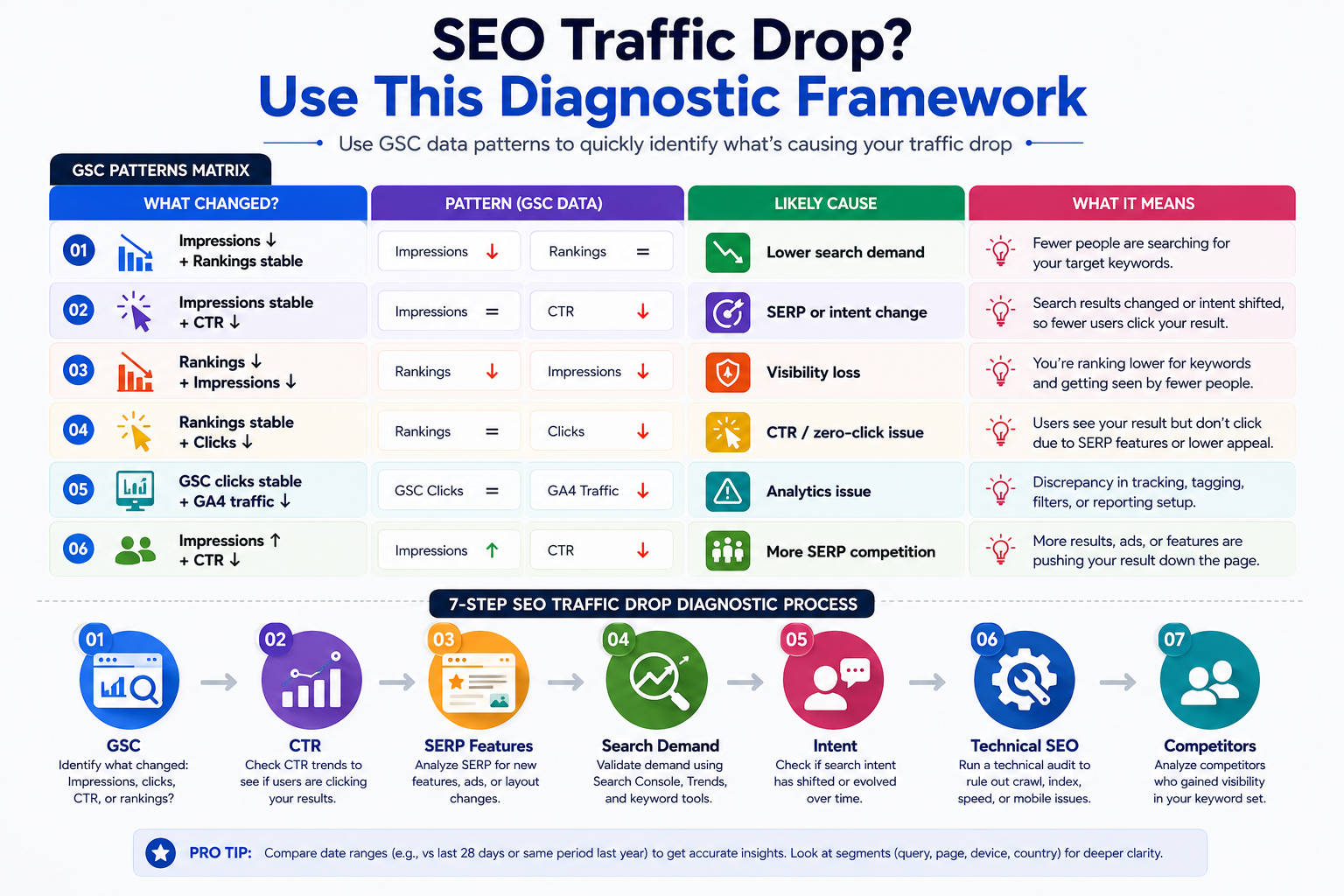
Step 1: Check Google Search Console
Start with the Performance report and compare the period with the previous period.
Look at clicks, impressions, CTR, average position, queries, and pages. The relationship between these metrics often provides the first clue.
| Performance Pattern | Likely Explanation |
| Impressions down + rankings stable | Lower search demand |
| Impressions stable + CTR down | SERP or intent change |
| Rankings down + impressions down | Visibility loss |
| Rankings stable + clicks down | CTR or zero-click search issue |
| GSC clicks stable + GA4 traffic down | Analytics issue |
| Impressions up + CTR down | More SERP competition |
Google has also introduced a Generative AI performance report in Search Console for a subset of site owners. Where available, it provides data related to appearances in AI Overviews and AI Mode.
Step 2: Compare CTR by Query and Page
Do not rely only on sitewide CTR. Find pages with substantial impressions and a noticeable CTR decline. Then identify the queries responsible for those impressions.
This can reveal that the traffic problem affects only certain topics rather than the entire website.
Step 3: Check for AI Overviews and Other SERP Features
Search your priority queries manually and examine the complete results page.
Look for AI Overviews, featured snippets, People Also Ask, videos, shopping results, local results, and zero-click search features.
Also compare what users see today with what they saw when the page generated more traffic to identify an AI Overviews traffic decline.
Step 4: Review Search Demand
Use Google Trends and keyword research data to determine whether overall interest has changed. If impressions have fallen alongside broader search demand, changing the content may not solve the problem.
Step 5: Reassess Search Intent
Compare your page with the current top results. Ask whether users now want a different format, a shorter answer, a comparison, a video, pricing information, product recommendations, or a local result.
Step 6: Audit Technical SEO
Check crawling, indexing, canonicalization, robots.txt, redirects, page performance, and analytics. Do not assume that stable rankings mean technical SEO can be ruled out.
Step 7: Compare Competitors
Finally, identify what competitors now do differently. Look at their SERP visibility, content format, freshness, titles, brand presence, third-party mentions, and appearance in AI-generated results.
This gives you a clearer explanation for a traffic decline than rankings alone.
Traditional SEO vs Answer Engine Optimization
SEO and AEO address different parts of modern search. SEO helps your pages rank and attract organic clicks, while AEO focuses on how your content appears in AI-generated answers.
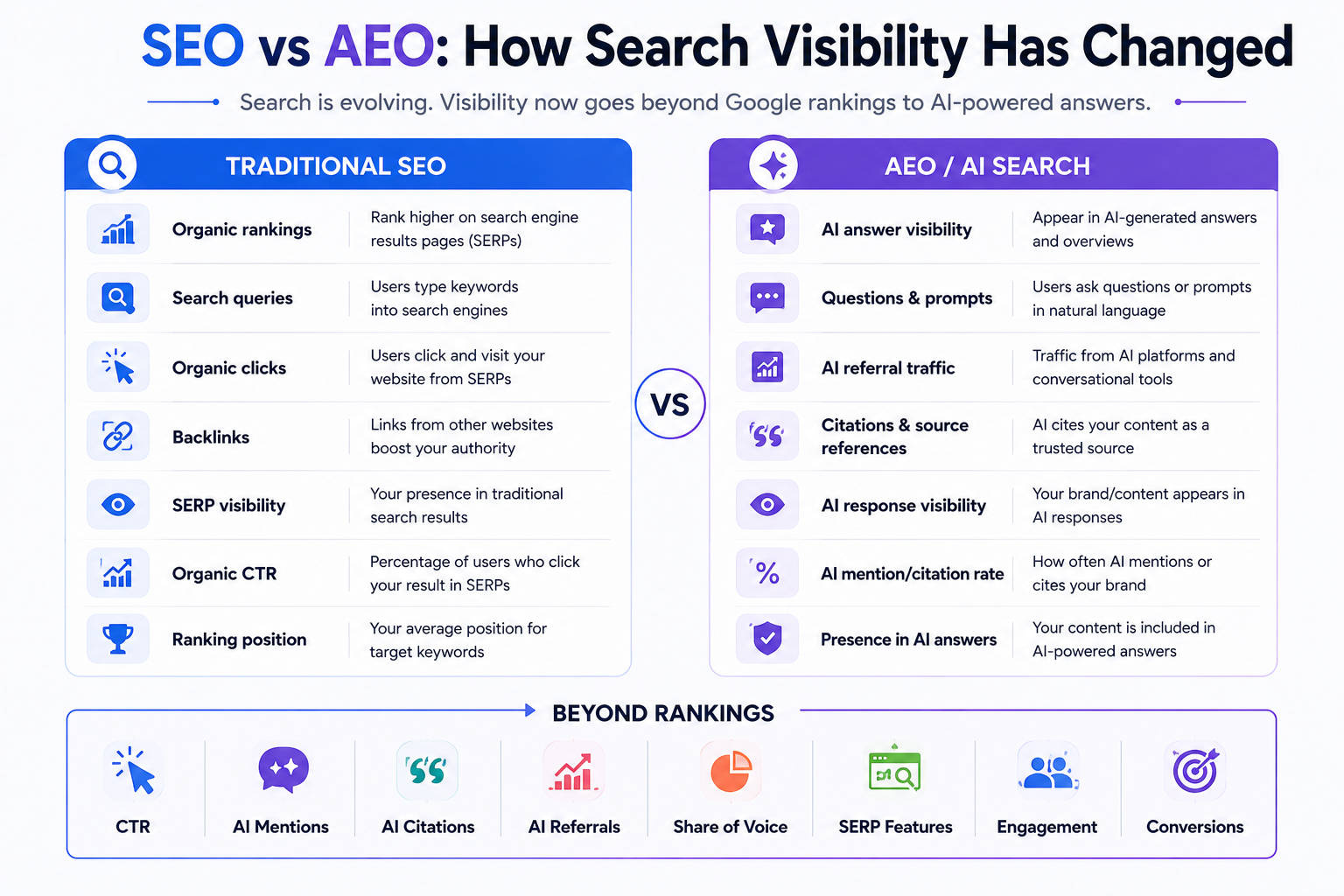
The table below highlights the key differences between the two approaches and the metrics each one focuses on.
| Traditional SEO | AEO / AI Search |
| Organic rankings | AI answer visibility |
| Search queries | Questions and prompts |
| Organic clicks | AI referral traffic |
| Backlinks | Citations and source references |
| SERP visibility | AI response visibility |
| Organic CTR | AI mention/citation rate |
| Ranking position | Presence in AI answers |
| Search visibility | Cross-channel answer visibility |
To sum up, as Google confirms, SEO will remain the foundation for visibility across traditional and AI-powered search, while AEO will complement it by helping content meet the needs of answer-first search.
How To Recover Lost Organic Traffic
Once you identify the cause, the recovery strategy should address that specific problem rather than apply the same SEO tactics across the entire website. Here’s how:
1. Optimize Content for Search and AI Answers
There is no reliable method to guarantee inclusion in an AI Overview. However, content can be structured so that important information is clear and easy to understand.
Use descriptive headings, direct answers, supporting evidence, relevant examples, and original information (first-party data, expert analysis). Put the answer close to the question rather than burying it under several paragraphs of background.
The same principle helps users. If someone asks a specific question, they should be able to find the answer quickly.
2. Improve Organic CTR
When rankings and impressions are stable, but clicks decline, CTR deserves attention.
Review title tags and descriptions for pages with strong impressions but weak click-through rates. Compare them with competing results and ask whether your result clearly communicates why someone should choose it.
For example, replace a generic title such as:
“CRM Software Guide”
with a more specific title that reflects the user’s intent:
“10 Best CRM Software for Small Businesses in 2026”
However, do not rewrite titles simply to make them more sensational. The title should accurately represent the content and match the user’s search intent.
3. Target More Specific Search Queries
Broad keywords often attract users with different needs. A more specific query can have clearer intent. Instead of focusing only on:
“project management software”
you may also target queries such as:
- project management software for small teams
- project management software with time tracking
- project management software for remote teams
That does not mean creating one page for every keyword variation. Instead, group related queries by intent and create pages that genuinely address each important need.
4. Refresh Declining Content
Older content can lose traffic when facts, examples, products, statistics, or user expectations change.
When refreshing a page, look beyond the publication date. Review whether the claims are still accurate, whether examples remain relevant, whether competitors cover important topics that you missed, and whether the current SERP expects a different content format.
A useful refresh changes the substance of the page rather than simply adding a few paragraphs.
5. Use Relevant Structured Data
Structured data can help search engines understand specific types of content and may make eligible pages suitable for certain rich-result features.
Use schema that accurately describes the page. Do not add markup solely because you expect it to improve rankings or AI visibility.
Structured data is one part of technical SEO. It should support clear, accessible content rather than replace it.
6. Create Answer-Focused Content
Answer-focused content gives users direct information without unnecessary detours.
Definitions, comparisons, step-by-step explanations, original research, expert commentary, and useful tables can all work well when they match the query.
The goal is not to write content specifically for an AI system. The goal is to make information clear, specific, well-supported, and easy to use.
That also makes it easier for search systems to understand the page.
7. Strengthen Brand and Topical Authority
A website’s visibility depends on more than individual pages.
Consistent coverage of a subject, expert-led content, original research, relevant backlinks, industry mentions, and credible references can all contribute to a stronger overall presence.
This matters for traditional search as well as AI search. When AI systems generate recommendations or cite sources, established and well-supported information can have an advantage over thin or unsupported claims.
Best AI SEO Platforms for Monitoring Search Visibility
AI search creates new visibility signals that traditional SEO tools may not fully capture. Below are the top AI SEO platforms that can help monitor mentions, citations, competitors, prompts, and AI visibility.
| Platform | Best For | AI Visibility | AI Citations | Competitor Tracking | Zero-Click Insights |
| HubSpot AEO | AEO strategy and brand tracking. | Yes | Yes | Yes | Tracks zero-click brand exposure. |
| Semrush AI Toolkit | Combined SEO + AI search visibility. | Yes | Yes | Yes | Measures traffic loss from AI Overviews. |
| Ahrefs Brand Radar | Brand monitoring across AI engines. | Yes | Yes | Yes | Tracks zero-click web mention gaps. |
| Profound | Enterprise AI search analytics. | Yes | Yes | Yes | Analyzes prompt discovery and LLM bots. |
| Peec AI | Tracking brand presence in AI responses. | Yes | Yes | Yes | Tracks brand sentiment in LLM answers. |
Let’s take a brief look at each platform and the specific AI search visibility needs it can help you track.
A. HubSpot AEO
HubSpot AEO tracks brand visibility across answer engines, with features for prompt monitoring, visibility analysis, citations, and competitor insights across platforms such as ChatGPT, Gemini, and Perplexity. It also fits into broader marketing workflows.
B. Semrush AI Toolkit
Semrush AI Visibility Toolkit combines AI search monitoring with traditional SEO workflows. It provides visibility data, competitor research, brand mentions, cited pages, and citation analysis, making it useful for SEO teams that already use Semrush for search performance.
C. Ahrefs Brand Radar
Ahrefs Brand Radar monitors brand visibility across AI search platforms and tracks AI share of voice, mentions, citations, cited pages, and competitors. It covers AI Overviews, AI Mode, ChatGPT, Gemini, Perplexity, Copilot, and other platforms.
D. Profound
Profound provides AI search visibility monitoring and analysis for organizations with broader AI search requirements. It helps teams examine how brands appear in AI-generated answers and compare visibility across AI search experiences.
E. Peec AI
Peec AI focuses on AI search analytics and visibility monitoring. It helps teams track how brands and competitors appear in AI-generated responses and assess visibility across answer engines as part of a broader AI search strategy.
Key Metrics to Monitor Beyond Rankings
Rankings show where your pages appear but not the full impact of search visibility. Here are the key metrics to track: clicks, engagement, AI visibility, SERP presence, and business outcomes.
A. Organic CTR
Organic CTR measures the percentage of search impressions that result in clicks on your listing.
Organic CTR Formula: (Organic Clicks ÷ Impressions) × 100
B. AI Mention Rate
AI Mention Rate measures how often your brand appears in responses to a defined set of AI prompts. This metric helps track brand visibility across AI search results.
AI Mention Rate Formula: (Responses With Brand Mention ÷ Total Responses) × 100
C. AI Citation Rate
AI Citation Rate measures how often your website is cited as a source in AI-generated responses. It helps assess your visibility as a trusted information source.
AI Citation Rate Formula: (Responses Citing Your Website ÷ Total Responses) × 100
D. AI Referral Traffic
AI Referral Traffic is the number of website visits that originate from AI platforms such as ChatGPT, Gemini, or Perplexity.
E. Share of Voice
Share of Voice measures your brand’s visibility against competitors across a defined set of searches or AI prompts. It helps benchmark your presence within your market.
SoV Formula: (Your Visibility ÷ Total Brand Visibility) × 100.
F. SERP Feature Visibility
SERP Feature Visibility is the frequency with which your pages or brand appear in features such as AI Overviews, featured snippets, videos, images, or local results.
G. Engagement
Engagement measures how users interact with your content after discovering it through search or AI platforms. It includes metrics such as engaged sessions, time on page, and key interactions.
H. Conversions and AI-Assisted Conversions
Conversions are completed actions such as purchases, leads, or sign-ups. AI-assisted conversions are conversions influenced by an earlier interaction with an AI platform.
What the Future of SEO Means for Your Strategy
The future of SEO will require a broader approach to search performance. Rankings will remain important, but SEO teams will need to consider how content performs across different search experiences and how effectively it supports the entire user journey.
This means shifting some strategic focus from individual keyword positions to search intent, content quality, brand authority, and business outcomes.
To prepare for future search, focus on the following strategic priorities:
- Create content that directly answers queries.
- Build strong topical authority.
- Support claims with credible sources.
- Track AI mentions and citations.
- Measure visibility beyond rankings.
In a nutshell, rankings will remain important but will increasingly work alongside broader measures of search visibility, brand authority, and meaningful traffic.
The Bottom Line:
The answer to why website traffic is dropping despite good SEO rankings is rarely found in rankings alone. Search is becoming more fragmented, so SEO success now depends on how well a website adapts to where and how people find information.
Keep core SEO practices strong, but also watch changes in SERPs, search behavior, and AI-driven discovery. Prioritize content that answers real questions, reflects current intent, and offers information users cannot get from a generic summary. Track qualified traffic, conversions, brand visibility, and AI mentions alongside rankings.
The key is not to chase every new search feature. It is to build a search strategy that can adapt as discovery changes while keeping your website useful, credible, and worth visiting.
Want to see how your brand is performing beyond traditional rankings? Explore HubSpot AEO to track AI visibility, citations, and competitor presence across AI search.
FAQs
1. Can seasonality cause traffic to drop despite stable rankings?
Yes. Search demand can fall during certain seasons. Compare current impressions with the same period last year in Google Search Console and Google Trends to confirm the pattern.
2. How can I tell if competitors are taking my traffic?
When rankings are good, but traffic is down, check your current SERPs against earlier results. If competitors now appear in more features such as videos, PAA, or featured snippets, they may capture more clicks.
3. Does branded search affect organic traffic?
Yes. A drop in branded searches can reduce organic traffic even when non-branded rankings remain stable. Check branded and non-branded queries separately in Search Console.
4. Can mobile search affect organic traffic?
Yes. Mobile results can show different layouts and SERP features than desktop. Compare clicks, CTR, rankings, and traffic by device to find differences.
5. Can outdated content cause traffic loss?
Yes. Outdated facts, statistics, examples, or product details can reduce relevance. Compare your page with current top results and update information that no longer matches user needs.
6. Can brand visibility affect AI search?
Yes. An AI Overview traffic decline can affect pages that once received clicks from informational queries. Check CTR, impressions, and AI Overview presence by query.
7. Why is SEO traffic decreasing despite stable rankings?
Why SEO traffic is decreasing depends on various causes such as lower search demand, declining CTR, SERP changes, shifting search intent, stronger competitors, technical issues, or algorithm updates.
